How to Count 6/8 Time: Compound Meter, 3/4 vs 6/8, and 12/8 Explained
Learn how to count 6/8 time: compound meter, the real difference between 3/4 and 6/8, counting systems, ♩. tempo markings, common rhythms, and 9/8 and 12/8.
You open a new piece, see 6/8 at the start, and hesitate. Do you count to six? Isn't that the same as 3/4, since both fit six eighth notes in a bar? These are completely reasonable questions, and they trip up a lot of players, because the 6/8 time signature is easy to miscount if you only read the numbers. The secret of 6/8 is not the six. It's the two.
This guide covers how to count 6/8 from the ground up: the difference between simple and compound meter, why 3/4 and 6/8 sound so different even though they're the same length, which counting system to use at which tempo, how compound tempo markings like ♩. = 60 work, the rhythms you'll see most often in 6/8, how 9/8 and 12/8 fit in, and a step-by-step practice routine with the most common mistakes. If note values and rests still feel unfamiliar, start with how to read sheet music and come back.
What the 6/8 time signature actually means
In any time signature, the bottom number tells you which note value is being counted and the top number tells you how many of them fit in a bar. So 6/8 literally means "six eighth notes per bar." That's the same rule that gives you four quarter notes in 4/4 and three in 3/4.
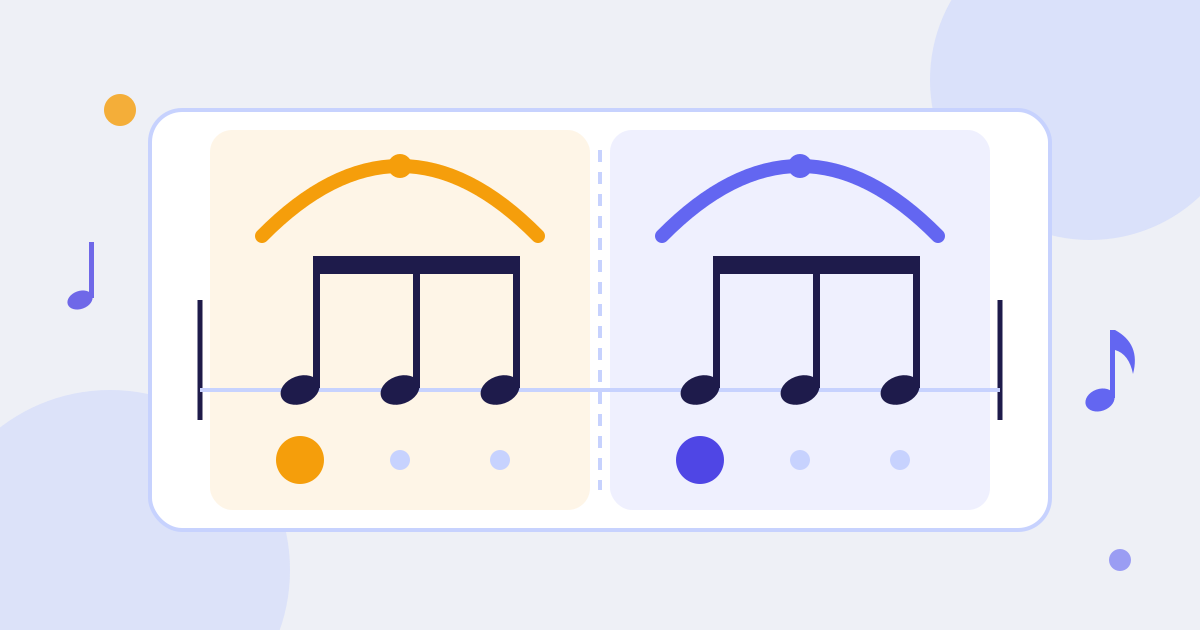
The difference comes next. In 6/8 those six eighth notes are grouped into two sets of three, and the first note of each set carries the weight. What your body actually feels as "the beat" isn't each eighth note but each group of three. Three eighth notes last exactly as long as one dotted quarter note (♩.), so here's the summary:
- One bar = six eighth notes = two dotted quarter notes
- One beat = a dotted quarter (♩.), which divides into three eighths
- Accents: eighth note 1 is strong, eighth note 4 is medium-strong, the rest are weak
In other words, 6/8 isn't "six beats." It's two beats, each split into three. If you clap or tap your foot to a piece in 6/8, two taps per bar feel natural. That "three inside two" structure is also what gives 6/8 its rolling, rocking quality, like a boat on swells or a cradle swaying.
Simple vs compound meter: does the beat split in two or in three?
Time signatures fall into two families: simple meter and compound meter. The only question that separates them is how the beat naturally divides.
- Simple meter: each beat divides into two. In 2/4, 3/4 and 4/4 the beat is a quarter note, and one beat = two eighth notes.
- Compound meter: each beat divides into three. In 6/8, 9/8 and 12/8 the beat is a dotted quarter, and one beat = three eighth notes.
| Time signature | Type | Beats per bar | Beat note | Beat divides into |
|---|---|---|---|---|
| 2/4 | Simple duple | 2 | Quarter ♩ | 2 eighths |
| 3/4 | Simple triple | 3 | Quarter ♩ | 2 eighths |
| 4/4 | Simple quadruple | 4 | Quarter ♩ | 2 eighths |
| 6/8 | Compound duple | 2 | Dotted quarter ♩. | 3 eighths |
| 9/8 | Compound triple | 3 | Dotted quarter ♩. | 3 eighths |
| 12/8 | Compound quadruple | 4 | Dotted quarter ♩. | 3 eighths |
There's a handy rule hiding in that table: in compound meter, divide the top number by 3 to get the real number of beats. 6/8 has two, 9/8 has three, 12/8 has four. That's why it helps to think of 6/8 as "2/4 in triplets" and 12/8 as "4/4 in triplets." A 4/4 song that's full of triplets from start to finish can be rewritten in 12/8 with no triplet brackets at all, for exactly that reason.
3/8 is not compound meter
A bottom number of 8 doesn't automatically mean compound. 3/8 has three eighth notes per bar; divide 3 by 3 and you'd get a single beat, so it's normally classified as simple triple, with the eighth note as the beat. At quick tempos players often feel a 3/8 bar as one big beat, much like a fast waltz counted "in one." It's enough to remember that the textbook category and the way you actually count can differ.
3/4 vs 6/8: the same six eighth notes, grouped differently
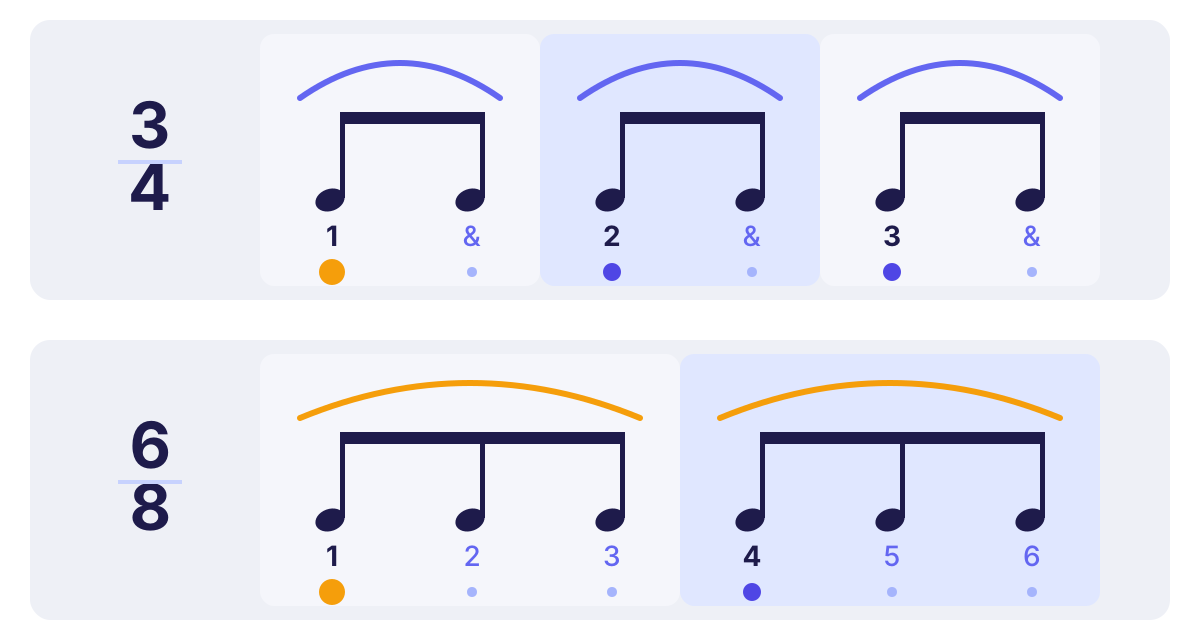
The most common question about this topic is 3/4 vs 6/8. Both bars hold six eighth notes, so they're the same length. What changes is how the notes are grouped and where the accents fall.
| 3/4 | 6/8 | |
|---|---|---|
| Eighth-note grouping | 2 + 2 + 2 | 3 + 3 |
| Beats per bar | 3 (quarter notes) | 2 (dotted quarters) |
| Accent pattern | Strong – weak – weak (by beat) | Strong – weak – weak – medium – weak – weak (by eighth) |
| Counting | 1 & 2 & 3 & | 1 2 3 4 5 6 / 1 la li 2 la li |
| Feel | "OOM-pah-pah" waltz, minuet | Rolling two-beat lilt, barcarolle, jig |
| Quarter + eighth | Lasts a beat and a half, crosses the beat | Fits neatly inside one beat (♩♪) |
You can hear the difference in ten seconds. Clap six even eighth notes and ① accent notes 1, 3 and 5: that's 3/4. Now ② accent notes 1 and 4: that's 6/8. You haven't changed a single note, yet the character of the rhythm flips completely.
Why is a waltz in 3/4 and not 6/8?
A waltz marks three distinct beats in every bar, bass on one and chords on two and three, so it's written in 3/4. Accompaniment in 6/8 instead rolls each group of three eighths together, so the bar sways twice. A fast waltz may be felt "in one," but the bar still contains three beats. On the page, a quarter note sitting on each beat points to 3/4, while eighth notes beamed in threes point to 6/8. Remember that beaming usually shows you the beat grouping.
How to count 6/8: three counting systems for different tempos
There's no single correct way to count 6/8. The slower the tempo, the more you count every eighth; the faster it gets, the more you count the two big beats. Whichever you choose, count out loud. If counting aloud isn't a habit yet, the counting section in how to practice rhythm is a good warm-up.
| System | One bar | When to use it |
|---|---|---|
| ① Count to six | 1 2 3 4 5 6 | Slow pieces, first learning, when every eighth has to land precisely |
| ② Beats + syllables | 1 la li 2 la li | Moderate to fast tempos, feeling the two big beats |
| ③ "One-and-a" | 1 & a 2 & a | Very common in band rooms and US method books |
| ④ Three-syllable words | straw-ber-ry straw-ber-ry | Teaching kids, or getting the feel into your body first |
① Counting to six (1-2-3-4-5-6)
This is where most people start. Say 1 and 4 louder and the rest softer: "ONE two three FOUR five six." If 1 and 4 don't get the weight, you may be counting the right numbers while really performing some other six-beat meter. For a slow 6/8 ballad where each eighth note feels long, counting to six is the most accurate approach.
② Beats plus syllables (1 la li 2 la li)
Once the tempo picks up, "1 2 3 4 5 6" gets tongue-tied, and worse, it hides the two big beats. So switch to numbers for beats and syllables for divisions. In "1 la li 2 la li," the numbers always land on the dotted-quarter beats, while "la" and "li" are the second and third eighth notes inside each beat. It works just like "1 & 2 &" in simple meter: any note that starts on a number is on the beat, any note that starts on a syllable is a subdivision.
③ "One-and-a" and ④ three-syllable words
Many American teachers count 6/8 as "1 & a 2 & a." Some rhythm-syllable methods use three syllables per beat, such as "ta-ki-da." Whatever you pick, the rules are the same: all three syllables are equal in length, and the first one lands exactly on the beat. Repeating a word with three even syllables, like "straw-ber-ry," on every beat is a surprisingly good drill.
Compound tempo markings: what does ♩. = 60 mean?
In 4/4 the tempo is usually marked on the quarter note, like ♩ = 100. In compound meters such as 6/8, 9/8 and 12/8, the dotted quarter is the beat, so the tempo is normally written on it as well: ♩. = 60 means sixty dotted-quarter beats per minute.
To convert that number to other note values, you only need one relationship: one dotted quarter = three eighths = one and a half quarters.
| Marking (♩.) | Eighth-note ♪ tempo | Quarter-note ♩ tempo | One bar of 6/8 lasts |
|---|---|---|---|
| ♩. = 40 | ♪ = 120 | ♩ = 60 | 3 seconds |
| ♩. = 60 | ♪ = 180 | ♩ = 90 | 2 seconds |
| ♩. = 80 | ♪ = 240 | ♩ = 120 | 1.5 seconds |
| ♩. = 100 | ♪ = 300 | ♩ = 150 | 1.2 seconds |
How to set your metronome for 6/8
- Moderate to fast 6/8: set the metronome to the ♩. number (say, 60) and treat each click as one big beat. Fill the space between clicks with an even "1 la li."
- Slow 6/8: set it to the eighth-note value (♩. × 3, so 40 becomes 120) and count 1 to 6 on the clicks. If that number exceeds your metronome's maximum, go back to clicking on the dotted quarter.
- Older editions and slow pieces sometimes mark the tempo on the eighth note from the start, for example ♪ = 120. You can read that as the composer telling you to feel the music in six.
If you'd like to connect tempo numbers with Italian terms like Andante and Allegro, see metronome practice and tempo markings.
Common rhythm patterns in 6/8
Most 6/8 rhythms are built inside a single dotted-quarter beat, three eighth-note slots wide. Get the six patterns below into your eyes and ears and you'll be able to read a large share of 6/8 music on sight. The numbers show eighth-note positions within the beat (1·2·3, or 4·5·6 for the second beat).
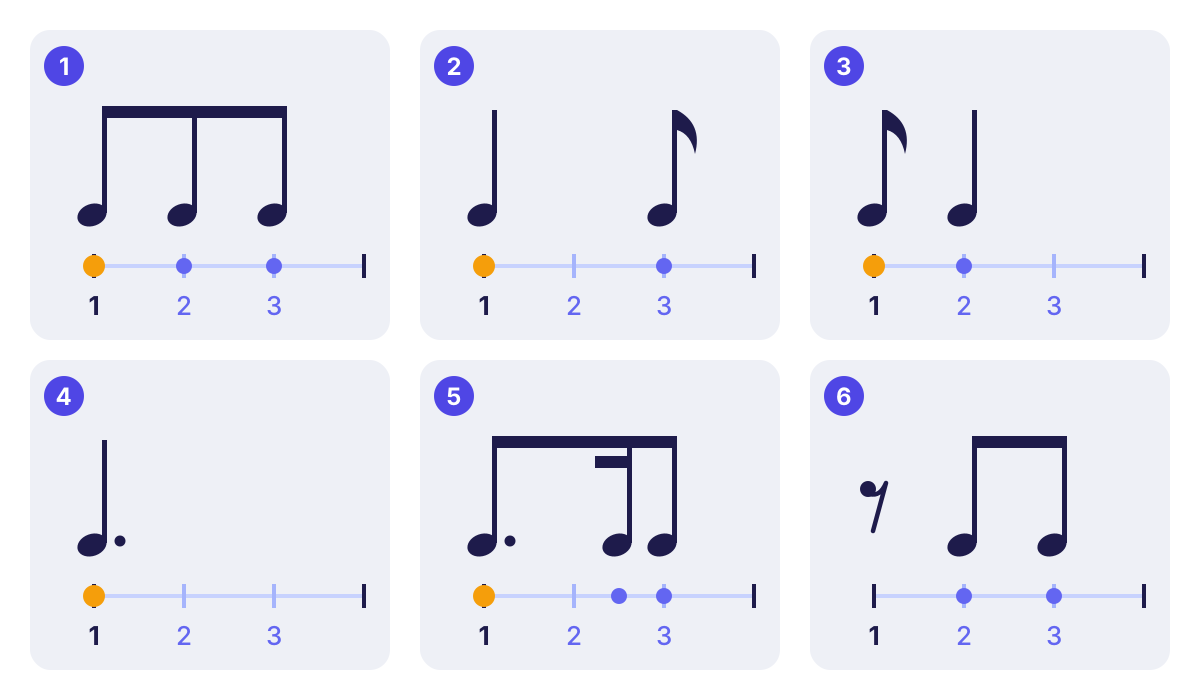
- ♪♪♪ (three eighths) — "1 2 3." The basic building block of 6/8. Keep them even, with a light lean on the first.
- ♩ ♪ (quarter + eighth) — "1 (2) 3." The most common long-short rhythm in 6/8, the one that gives jigs and galloping figures their bounce. Hold the quarter through 2 or the eighth will rush.
- ♪ ♩ (eighth + quarter) — "1 2 (3)." The reverse of pattern 2; the longer second note creates a gentle pull.
- ♩. (dotted quarter) — One note fills the whole beat. Keep counting "1 la li" inside it, or the next beat will be late.
- ♪. ♬ ♪ (dotted eighth + sixteenth + eighth) — The graceful lilting figure you hear in sicilianas. The sixteenth sits exactly halfway between 2 and 3; subdividing as "1 · 2 and 3" helps you place it.
- 𝄾 ♪♪ (eighth rest + two eighths) — Leave the first slot empty and come in on 2 and 3. Whisper "1" on the rest so your entry doesn't drift.
You'll also see two beats tied together, or a whole bar filled by a single dotted half note (two dotted quarters long). As in simple meter, the second note of a tie is counted, not played.
Duplets: "two" inside compound meter
Simple meter needs a triplet to divide a beat into three. Compound meter needs a duplet to divide a beat evenly into two. It's written as two eighth notes with a 2 over them, meaning "two in the space of three," and the same rhythm is sometimes notated as two dotted eighths. Each note is exactly half a beat, so stop thinking in three eighths and simply cut the beat in half. For the opposite case, see how to play triplets.
Hemiola: when two and three trade places
A hemiola is a rhythmic device in which groupings of three and two swap places within the same span of time. In 6/8 that usually means briefly accenting the six eighths in three pairs, as if the bar were 3/4. "America" from West Side Story is the classic example people point to, alternating bars of 6/8 and 3/4. Hemiolas are also a fixture at cadences in Baroque dance movements. Once the 3/4-vs-6/8 contrast above is in your body, hemiolas become easy to hear.
9/8, 12/8 and where you'll hear 6/8
Once 6/8 makes sense, the other compound meters just add beats.
- 9/8: three groups of three = compound triple. "1 la li 2 la li 3 la li." The Irish slip jig is the classic example.
- 12/8: four groups of three = compound quadruple. "1 la li 2 la li 3 la li 4 la li." It's everywhere in slow blues and in 1950s and '60s soul and doo-wop ballads. Because it feels just like constant triplets over 4/4, shuffle and swing grooves are sometimes written in 12/8 too.
For more on how shuffle and swing relate to triplets, see the swing section of classical vs jazz piano.
Where 6/8 shows up
- Irish and Scottish jigs: fast dance tunes driven by a nonstop ♩♪ pattern.
- Tarantella and siciliana: the tarantella is a fast, whirling 6/8; the siciliana is a slow, swaying 6/8 (or 12/8).
- Barcarolles and lullabies: the two-beat sway of 6/8 is a natural fit for rowing and rocking.
- Pop and rock ballads: songs with rolling arpeggiated accompaniment, such as The Animals' "House of the Rising Sun," are commonly played in 6/8. "Silent Night" is also often written in 6/8.
- Marches: surprisingly many marches are in 6/8. At a brisk tempo its two beats match a left-right step perfectly.
On guitar, 6/8 ballads are often strummed in threes ("down-down-up, down-down-up") or picked as rolling arpeggios. For pattern drills, continue with guitar strumming rhythm practice.
A step-by-step 6/8 practice routine and common mistakes
The key to 6/8 is feeling two beats while filling each one with three even notes. Ten minutes a day of the routine below will make 6/8 notation feel much friendlier within a week or two.
- Two in the feet, six in the hands Sit down, tap your foot twice per bar (on 1 and 4), and clap or pat six even eighth notes. Set the metronome around ♩. = 50 and lock the clicks to your foot.
- Switch counting systems Keep the same motion and change only the counting: "1 2 3 4 5 6" → "1 la li 2 la li." Check that the numbers line up with your foot and the syllables fall evenly in between.
- Alternate with 3/4 Keep six steady eighths. Accent 1 and 4 in one bar (6/8), then 1, 3 and 5 in the next (3/4). Once you can feel the beat change with nothing but accents, hemiolas will start to sound natural.
- Pattern cards Pick two patterns from the figure above and join them into a bar (for example ♩♪ + ♪♪♪). Clap it while your foot holds the two beats. When it's comfortable, move from ♩. = 60 to 70 to 80.
- Apply it to your instrument and a piece Choose the two hardest bars of a piece, clap the rhythm first, then add pitches on your instrument. Pianists can go hands separately; guitarists can lock in the rhythm with muted strums before adding chords.
Common mistakes in 6/8
- Giving all six eighths equal weight — Without accents on 1 and 4, 6/8 loses its sway and turns into a mechanical six. Make 1 the strongest and 4 the next strongest.
- Rushing the eighth in ♩♪ — Clip the quarter and the eighth arrives early, producing an awkward pseudo-shuffle. Check that the quarter fills exactly two eighth slots with "1 (2) 3."
- Coming in late after a dotted quarter — If your count stops on a long note, the next beat arrives late. The longer the note, the more important it is to keep counting "la li" inside it.
- Mixing up tempo units — Reading ♩. = 60 as ♩ = 60. Use the tempo table above and decide what note your click stands for.
- Treating 3/4 and 6/8 as the same thing — Same length doesn't mean same accents or same accompaniment. Look at the beaming first: threes or twos?
Hear 6/8 rhythms first with Rhythm Helper
If you can't quite imagine how a 6/8 rhythm should sound, try hearing it in Rhythm Helper before you play it. Set the time signature to 6/8 (or 3/8, 9/8 or 12/8), enter notes, rests, dotted notes and ties exactly as written, and it plays that rhythm back with a click on each note while highlighting the note you should be playing. In 6/8, 9/8 and 12/8 the tempo is shown as ♩. = N, just like real sheet music, so you can copy the number straight from your score (3/8 is treated as a simple meter and shown on the quarter note). You can also enter duplets in compound meter, so it's an easy way to hear exactly how the duplets described above should sound.
The free version runs in your web browser with no install and handles two bars, which is plenty for the two-pattern bars from the routine above; Pro extends that to 32 bars. Listen first, then clap along with the highlighting, and finally count it yourself without the app.
6/8 can look confusing because of its numbers, but once "two big beats, three inside each" clicks, it becomes one of the most natural-feeling meters there is. Start today by tapping two beats with your foot and counting "1 la li 2 la li" out loud.
Frequently asked questions
How many beats are in a bar of 6/8?
There are six eighth notes per bar, but because they're grouped in threes and felt as dotted-quarter beats, 6/8 has two beats per bar (compound duple). In slow pieces you may count all six eighths, but the accents always fall on 1 and 4.
What is the difference between 3/4 and 6/8?
Both bars contain six eighth notes. 3/4 groups them in pairs to make three quarter-note beats (strong-weak-weak), while 6/8 groups them in threes to make two dotted-quarter beats (strong-weak-weak-medium-weak-weak). Accent eighths 1, 3 and 5 and you hear 3/4; accent 1 and 4 and you hear 6/8.
What is the best way to count 6/8?
For slow pieces or when you're first learning, count "1 2 3 4 5 6" with accents on 1 and 4. At moderate and faster tempos, count the two beats as numbers and the divisions as syllables, such as "1 la li 2 la li" or "1 & a 2 & a." Whatever you choose, count out loud.
What metronome setting do I use for ♩. = 60?
It means sixty dotted-quarter beats per minute, so set the metronome to 60 and treat each click as one big beat. If you'd rather click every eighth note, use three times that number (180); converted to quarter notes, it's 90.
Is 3/8 a compound time signature?
No. 3/8 is classified as simple triple meter, with the eighth note as the beat, although at fast tempos it's often felt in one. Compound meters have a top number that is a multiple of three greater than three, such as 6/8, 9/8 and 12/8.
Is 12/8 the same as 4/4 with triplets?
In terms of what you hear, essentially yes. 12/8 has four dotted-quarter beats, each divided into three eighths, which is the same flow as playing eighth-note triplets on every beat of 4/4. When a whole piece moves in threes, writing it in 12/8 avoids a page full of triplet brackets.