How to Read Sheet Music: A Complete Beginner's Guide to Notes and Rhythm
Learn how to read sheet music from scratch: the staff, treble and bass clefs, note names, sharps and flats, note values, time signatures, repeats, and a simple practice routine.
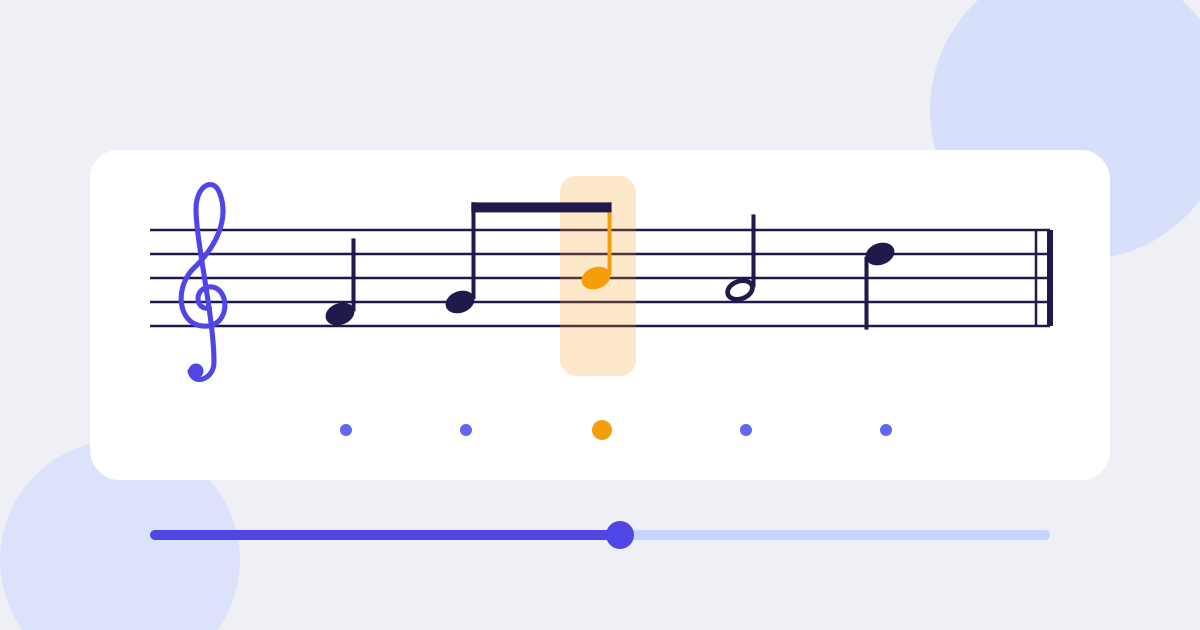
Learning how to read sheet music can feel like decoding a foreign alphabet, but every page answers just two questions: which note (pitch) and for how long (rhythm). This guide walks a complete beginner through both — the staff and clefs, note names, sharps and flats, note values and rests, time signatures, repeat signs, dynamics and tempo markings — and finishes with a practical way to read rhythm on its own and a 15-minute daily routine. Whether you are teaching yourself piano or returning to music after years away, you can work through it in order.
How to read sheet music: the big picture
Think of sheet music as a graph. Height on the page tells you pitch — the higher the note sits, the higher it sounds. Left to right is time — you play notes in the order you read them. On top of that, the shape of each note (hollow or filled head, stem, flags) tells you how long it lasts, and the time signature at the start tells you how time is divided into equal chunks.
Because those are two separate skills, it helps to practice them separately. Pitch reading is mostly pattern recognition: seeing a position on the staff and knowing its name instantly. Rhythm reading is timing: feeling how many beats a note gets while a steady pulse keeps going. Many beginners memorize note names quickly and then stall on rhythm, because rhythm cannot be learned by looking alone — you have to count and make sound.
Here is everything a typical page of music tells you:
- Pitch: position on the staff + clef + key signature and accidentals
- Duration: note and rest shapes + dots + ties
- The time grid: time signature, measures, and bar lines
- Road map: repeat signs, D.C., D.S., and Coda
- Expression: dynamics (p, f), tempo markings (Andante, Allegro), slurs
You do not need all of it on day one. Learn the pieces below in order and simple songs and method-book pieces will be readable within a few weeks.
The staff, treble clef, bass clef, and grand staff
The staff and ledger lines
Music is written on a staff (British: stave) of five horizontal lines and the four spaces between them. Lines and spaces are counted from the bottom up. A note either sits on a line (the line runs through its head) or in a space. Moving from a line to the next space, then to the next line, raises the pitch one step through the musical alphabet: A, B, C, D, E, F, G, and then back to A.
Notes that go above or below the staff get short extra lines called ledger lines. They are just temporary extensions of the staff, so the same line-space-line pattern continues. Notes with three or four ledger lines are slow to count, so it pays to memorize the handful that show up often.
Treble clef (G clef)
The five lines alone do not tell you which note is which. A clef anchors the staff to a specific pitch. The treble clef curls around the second line from the bottom, marking it as G above middle C — which is why it is also called the G clef. In treble clef the lines, bottom to top, are E–G–B–D–F ("Every Good Boy Does Fine") and the spaces spell F–A–C–E ("FACE"). Treble clef is used for the piano's right hand, voice, violin, flute, and guitar (guitar music sounds an octave lower than written).
Bass clef (F clef)
The bass clef puts its two dots on either side of the fourth line, marking it as F below middle C. Its lines are G–B–D–F–A ("Good Boys Do Fine Always") and its spaces are A–C–E–G ("All Cows Eat Grass"). A handy shortcut: each position in bass clef is named two letters later in the alphabet than the same position in treble clef — the bottom line is G instead of E, the bottom space A instead of F. Bass clef is used for the piano's left hand, cello, bass guitar, trombone, and tuba.
The grand staff and middle C
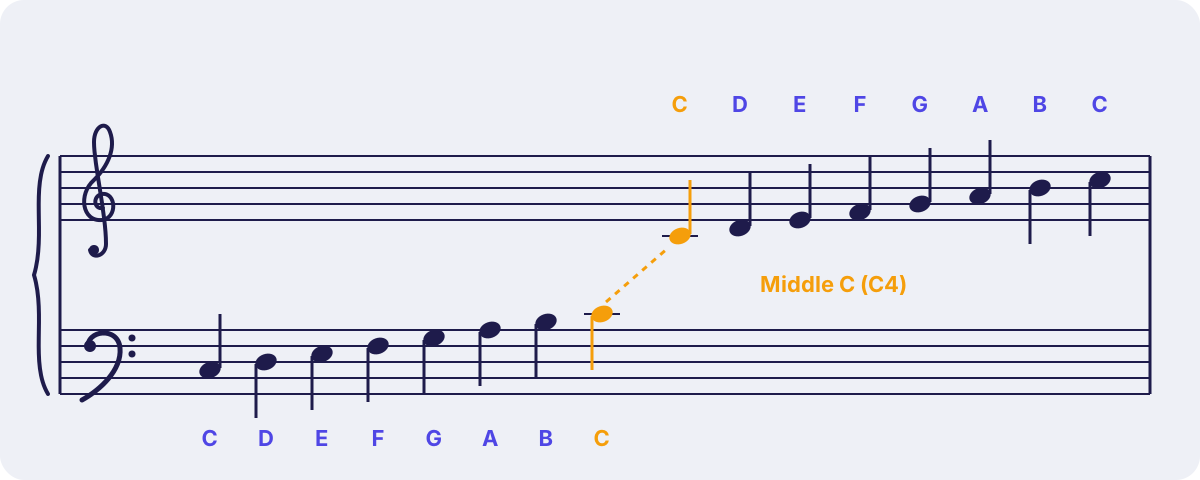
Piano music joins a treble staff and a bass staff with a brace; together they form the grand staff (British: great stave). The note exactly between them is middle C (C4). It can be written on one ledger line below the treble staff or one ledger line above the bass staff — both spellings are the same key. On most pianos, middle C is the C closest to the center of the keyboard, usually near the brand logo.
Note names, sharps and flats, and key signatures
Letter names vs. do-re-mi
English-speaking musicians name notes with letters: C, D, E, F, G, A, B. The seven white keys repeat that pattern across the keyboard; C is the white key just left of each group of two black keys. You will also hear solfège — do, re, mi, fa, sol, la, ti — which in the US is usually "movable do" (do is the home note of whatever key you are in). Other countries use different systems, which matters if you ever read foreign method books:
| English / German | Solfège (fixed do) | Korean | Japanese |
|---|---|---|---|
| C | do | 다 (da) | ハ (ha) |
| D | re | 라 (ra) | ニ (ni) |
| E | mi | 마 (ma) | ホ (ho) |
| F | fa | 바 (ba) | ヘ (he) |
| G | sol | 사 (sa) | ト (to) |
| A | la | 가 (ga) | イ (i) |
| B (German: H) | si / ti | 나 (na) | ロ (ro) |
The number after a letter is the octave. In scientific pitch notation, middle C is C4, the C above it is C5, and the C below it is C3. Some keyboards and music software label middle C as C3 instead, so check the convention when it matters.
Accidentals: sharp, flat, natural
A symbol placed directly to the left of a note is an accidental:
- ♯ Sharp raises the note a half step. F♯ is the black key just right of F.
- ♭ Flat lowers the note a half step. B♭ is the black key just left of B.
- ♮ Natural cancels a sharp or flat (including one from the key signature) and returns to the plain note.
The key rule: an accidental lasts until the end of the measure. If the same line or space appears again in that measure, it keeps the sharp or flat even without a new symbol. The bar line cancels it — except when a note is tied across the bar line, in which case the tied note keeps the accidental. Double sharps (𝄪) and double flats (𝄫) exist but rarely appear in beginner music.
Key signatures
Sharps or flats grouped right after the clef form the key signature. They apply to that note in every octave for the whole piece (or until the key signature changes). Sharps always appear in the order F–C–G–D–A–E–B, flats in the order B–E–A–D–G–C–F. One sharp (F♯) means G major or E minor; one flat (B♭) means F major or D minor. Two quick tricks for major keys: the key is a half step above the last sharp, and with two or more flats, the second-to-last flat names the key.
Note values and rests: how long each note lasts
Now for rhythm. The easiest way to understand note values is that each one is half the previous. One whole note equals two half notes, four quarter notes, eight eighth notes, or sixteen sixteenth notes. The American names literally describe the fraction of a whole note.
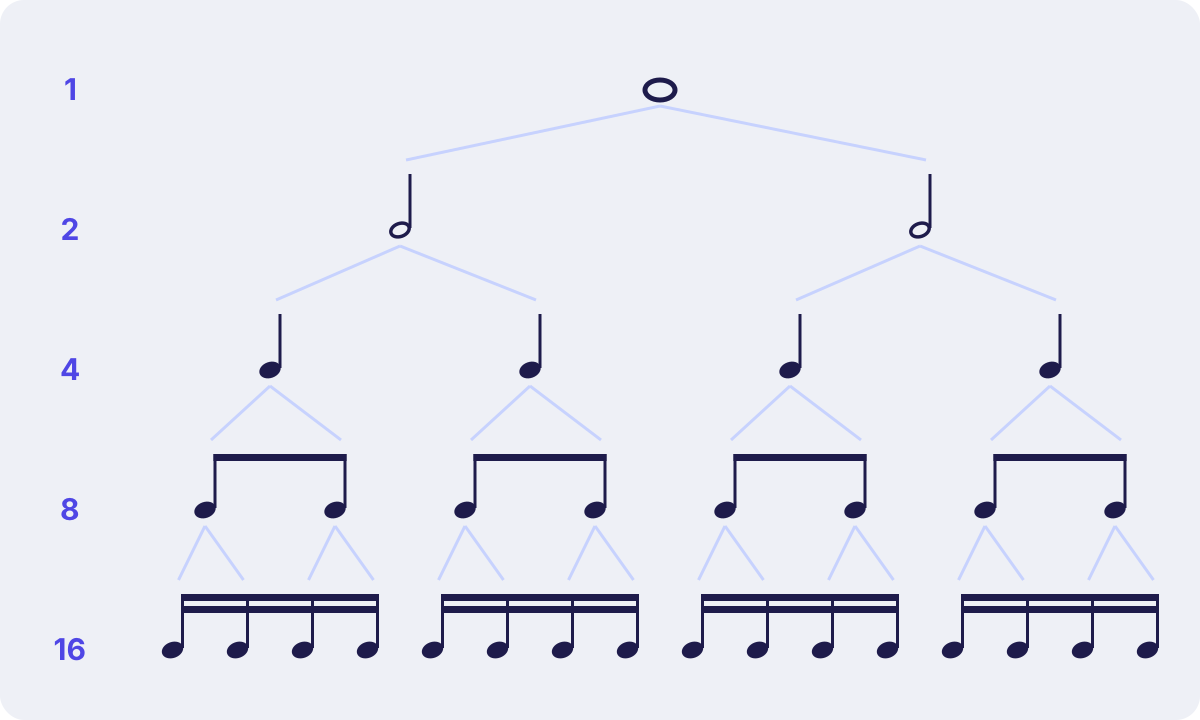
To identify a note, check three things in order: is the head hollow (whole, half) or filled; is there a stem; and how many flags or beams does it have? One flag is an eighth note, two a sixteenth, three a thirty-second. When several eighths or shorter notes appear in a row, their flags are replaced by thick beams that group them by beat, which makes the pulse easier to see. Stem direction has nothing to do with length: notes below the middle line get stems up, notes above it get stems down.
British English uses different names, which you will see in UK exam syllabi such as ABRSM: whole = semibreve, half = minim, quarter = crotchet, eighth = quaver, sixteenth = semiquaver, thirty-second = demisemiquaver.
| Note (US) | UK name | Beats in 4/4 | Matching rest | How the rest looks |
|---|---|---|---|---|
| Whole note | Semibreve | 4 | Whole rest | Block hanging from the 4th line |
| Half note | Minim | 2 | Half rest | Block sitting on the 3rd line |
| Quarter note | Crotchet | 1 | Quarter rest | Zigzag, like a lightning bolt |
| Eighth note | Quaver | 1/2 | Eighth rest | Dot with one flag (like a 7) |
| Sixteenth note | Semiquaver | 1/4 | Sixteenth rest | Dot with two flags |
| 32nd note | Demisemiquaver | 1/8 | 32nd rest | Dot with three flags |
Whole and half rests look almost identical. Remember: the "heavier" whole rest hangs down from a line like a hole, while the half rest sits on a line like a hat. The whole rest also doubles as a full-measure rest in any meter — even in 3/4, a completely silent measure gets a whole rest.
Dotted notes: one and a half times as long
A dot after a note adds half of that note's value. A dotted half note is 2 + 1 = 3 beats; a dotted quarter is 1 + ½ = 1½ beats; a dotted eighth is ½ + ¼ = ¾ of a beat. The pattern "dotted quarter + eighth" adds up to two beats and is everywhere in folk songs and pop, so practice it out loud until it feels natural. Rests can be dotted too, with the same math.
Ties vs. slurs
Two curved lines look alike but mean very different things:
- A tie connects two notes of the same pitch. Play the note once and hold it for the combined length. Ties are how notation sustains a note across a bar line.
- A slur spans notes of different pitches. It means play them smoothly connected (legato) — it does not change any durations.
You will also meet tuplets. A triplet, marked with a 3, squeezes three notes into the space normally taken by two: three triplet eighths fill one quarter-note beat.
Time signatures explained: 4/4, 3/4, 6/8, and measures
The stacked numbers after the clef and key signature are the time signature. The top number tells you how many beats are in each measure; the bottom number tells you which note gets one beat — 4 means a quarter note, 8 an eighth note, 2 a half note. So 4/4 means four quarter-note beats per measure, and 3/4 means three. You will sometimes see 4/4 written as C ("common time") and 2/2 as ¢ ("cut time").
Why 6/8 is felt in two
6/8 contains six eighth notes per measure, but they are grouped 3 + 3, so the music is felt as two beats, each a dotted quarter note. Meters whose beats divide into three are called compound meters: 6/8, 9/8, and 12/8 are the common ones. Compare 3/4, which also holds six eighth notes but groups them 2 + 2 + 2 — three beats. The beaming tells you which one you are looking at. 3/8, by contrast, is a simple meter with three eighth-note beats, though at fast tempos it is often felt as one beat per measure.
| Time signature | Beats per measure | Beat unit | Feel / typical use |
|---|---|---|---|
| 2/4 | 2 | Quarter note | Marches, polkas — STRONG-weak |
| 3/4 | 3 | Quarter note | Waltzes, minuets — STRONG-weak-weak |
| 4/4 | 4 | Quarter note | Most pop and rock — strong, weak, medium, weak |
| 6/8 | 2 | Dotted quarter | Jigs, lilting ballads, "rocking" feel |
| 9/8 | 3 | Dotted quarter | Three beats, each split in three |
| 12/8 | 4 | Dotted quarter | Slow blues, shuffle-feel ballads |
Measures and bar lines
Vertical bar lines slice the music into measures (British: bars), each holding exactly the amount of time the time signature says. In 4/4, the notes and rests in every measure add up to four beats. That gives you a built-in self-check: if a measure confuses you, add up the values and see whether you get four. A double bar line (two thin lines) marks the end of a section; a thin line followed by a thick one is the final bar line. When a piece starts partway through a beat, the short opening measure is a pickup (anacrusis), and the last measure is usually shortened to match.
Repeat signs, dynamics, and tempo markings
Repeats, D.C., D.S., and Coda
You normally read left to right, but repeat signs change the route:
- Repeat signs are bar lines with two dots. At an end repeat (:‖) go back to the matching start repeat (‖:) and play the section again; if there is no start repeat, go back to the beginning.
- First and second endings (bracketed 1. and 2.): play the first ending, go back, then on the repeat skip it and jump to the second ending.
- D.C. (da capo) means "from the head" — go back to the beginning. D.C. al Fine means return to the start and stop at Fine.
- D.S. (dal segno) means go back to the segno sign (𝄋).
- Coda (𝄌) is a separate ending section. D.S. al Coda means go back to the sign, play until "To Coda," then jump to the coda.
By common convention, internal repeats are not taken again after a D.C. or D.S., unless the music says otherwise. Before playing a new piece, trace the road map with your finger — it prevents most wrong turns.
Dynamics
Volume is written with Italian abbreviations, from soft to loud: pp (pianissimo, very soft), p (piano, soft), mp (mezzo piano, medium soft), mf (mezzo forte, medium loud), f (forte, loud), ff (fortissimo, very loud). An opening hairpin (<) or cresc. means gradually louder; a closing hairpin (>), dim., or decresc. means gradually softer.
Tempo markings and BPM
An Italian word at the top of the music is a tempo marking. A metronome mark such as ♩ = 80 means 80 quarter-note beats per minute (BPM). The BPM ranges for tempo words vary by era and source, so treat this table as a rough guide:
| Tempo marking | Meaning | Approx. BPM |
|---|---|---|
| Largo | Very slow, broad | 40–60 |
| Adagio | Slow | 66–76 |
| Andante | At a walking pace | 76–108 |
| Moderato | Moderate | 108–120 |
| Allegro | Fast, bright | 120–156 |
| Vivace | Lively, fast | 156–176 |
| Presto | Very fast | 168–200 |
In compound meters like 6/8, the metronome mark is often given for the dotted quarter (♩. = 60). The same number with a different beat note means a different actual speed, so always check which note the number refers to.
Reading rhythm first: clapping and counting
Most slow sight-readers are trying to solve pitch and rhythm at the same time and end up losing both. The fix is simple: ignore pitch and read the rhythm by itself first.
Count "1 & 2 &"
Count quarter-note beats as "1, 2, 3, 4." When eighth notes appear, add "and" between beats: "1 & 2 & 3 & 4 &." For sixteenth notes, split each beat in four: "1 e & a" ("one-ee-and-uh"). For triplets, fit three even syllables into a beat — "1-trip-let" or "tri-pl-et." The golden rule: your counting voice keeps a steady pulse, and your hands clap only where a note begins.
Take a 4/4 measure of quarter – two eighths – dotted quarter – eighth. Count and clap it as "1, 2 &, 3 (& 4) &": clap on the bold syllables and only speak the ones in parentheses. Because the dotted quarter starts on 3 and lasts through 4, the final eighth lands on the "&" of 4. For long notes, keep your palms pressed together for the full length; for rests, open your hands. Turning duration into a physical motion makes it stick.
How to check that you read it correctly
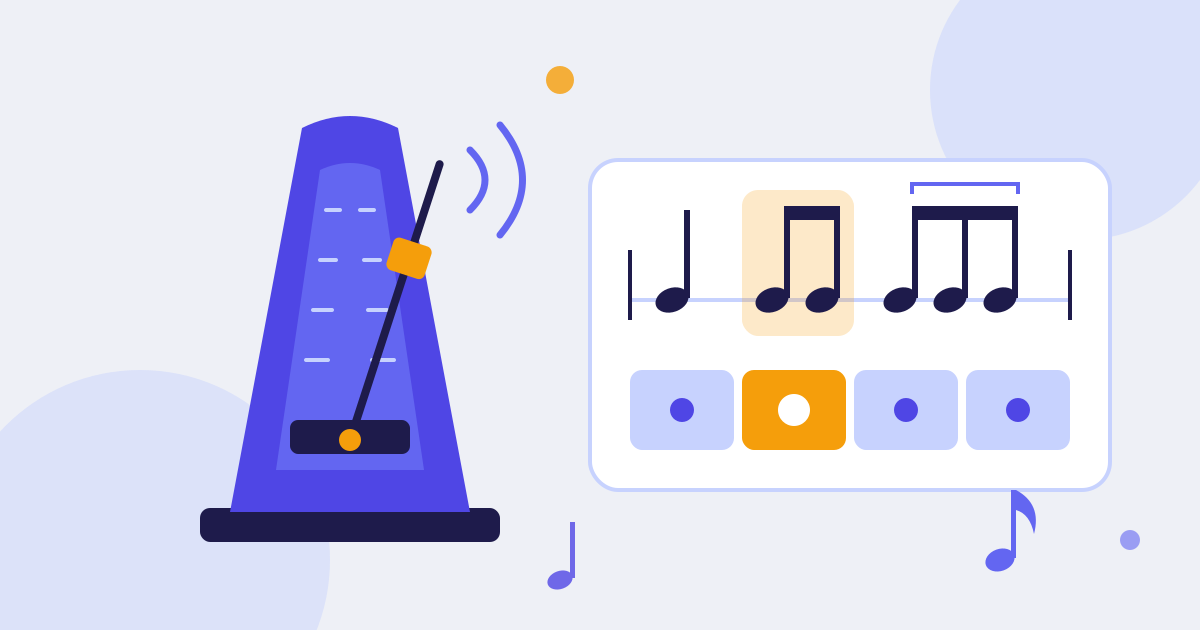
The biggest problem with practicing alone is that you cannot hear your own mistakes. A metronome only ticks the beat; it will not tell you whether you played a dotted rhythm or a tie correctly. This is where Rhythm Helper is useful. Set the time signature and tempo, enter one measure of the score note for note and rest for rest, and it draws the rhythm in notation and plays it back with a click, highlighting each note as it sounds. Clap it yourself first, then press play and compare — mistakes like holding a dotted eighth too long or re-striking a tied note become obvious immediately. It is a rhythm-only tool and does not play pitches, so practice melodies on your instrument.
To build steadier timing beyond reading, see our guide to rhythm and timing practice.
A 15-minute daily practice routine for reading music
Reading music improves far faster with short daily sessions than with occasional long ones. Try this order:
- Landmarks (2 min) Name treble G, bass F, and middle C, then check the clef, key signature, and time signature of today's piece before you play anything.
- Rhythm only (4 min) Ignore pitch. Clap one line while counting "1 & 2 &" at a slow tempo (around ♩ = 60). If a measure trips you up, add up its values to check it.
- Check the rhythm (2 min) Play the tricky measures back with a tool like Rhythm Helper, or listen to your teacher or a recording, and compare with your clapping.
- Note names only (3 min) Now ignore rhythm and say the note names aloud. Counting up from landmarks is fine at first; try to shorten that counting each time you repeat the piece.
- Put it together slowly (3 min) Combine rhythm and pitch on your instrument. The goal is to keep the beat going even when you miss a note.
- One new line of sight-reading (1 min) Read one line of music you have never seen. Easy children's songs or beginner method pieces are perfect.
If you are learning on piano, our beginner's guide to teaching yourself piano lays out the first months, and the piano method books guide helps you pick a series that builds reading step by step.
Frequently asked questions
Can I teach myself to read sheet music?
Yes. Once you know the clefs and landmark notes, note and rest values, and time signatures, you can read simple music on your own. Rhythm mistakes are hard to notice by yourself, though, so check your reading against a recording or a tool that plays the rhythm back.
How long does it take to learn to read music?
It varies, but with about 15 minutes a day most beginners can read simple one-hand melodies in two to four weeks. Reading both hands of the grand staff fluently usually takes several months or more, so be patient.
What is the easiest way to remember treble and bass clef notes?
Use the mnemonics — treble lines E-G-B-D-F ("Every Good Boy Does Fine"), spaces F-A-C-E; bass lines G-B-D-F-A ("Good Boys Do Fine Always"), spaces A-C-E-G ("All Cows Eat Grass") — and anchor everything to three landmarks: treble G, bass F, and middle C.
How do you count 6/8 time?
Count six eighth notes in two groups, "1-2-3, 4-5-6," with accents on 1 and 4. At moderate or fast tempos, feel each group as one dotted-quarter beat, so the measure has two beats.
What is the difference between a tie and a slur?
A tie joins two notes of the same pitch: play once and hold for both values combined. A slur covers notes of different pitches and means play them smoothly connected. Check whether the curved line joins identical pitches.
What are crotchets, quavers, and minims?
They are the British names for note values: a crotchet is a quarter note, a quaver an eighth note, a minim a half note, and a semibreve a whole note. A semiquaver is a sixteenth note.