How to Practice Rhythm: A Complete Guide to Improving Your Timing
Learn how to practice rhythm step by step: counting, metronome practice, subdivision and syncopation exercises, and a 4-week plan to improve your timing.

Maybe you sound fine playing alone, but the moment the metronome comes on you drift. Or you rush every time the band hits the chorus. Almost every musician runs into this at some point, and the good news is that timing responds very well to the right kind of work. This guide walks you through how to practice rhythm from the ground up: what pulse and subdivision actually are, how to count rhythms out loud, a five-stage metronome routine, subdivision and syncopation exercises, how to apply all of it to piano, guitar and band practice, and a four-week plan you can start today.
The core idea is simple. Solid timing comes from three separate abilities: keeping a steady beat in your body (pulse), dividing that beat evenly (subdivision), and knowing what a written rhythm is supposed to sound like. Train them one at a time and rhythm stops being a matter of "feel" you either have or don't.
What "good timing" really means: pulse, beat and subdivision
Before you start rhythm practice, it helps to name the parts. "My timing is off" can mean several different problems, and each one has a different fix.
Pulse: the steady heartbeat under the music
The pulse is what makes you tap your foot when a song comes on. Tempo, measured in BPM (beats per minute), tells you how often that pulse arrives. At 60 BPM you get one beat per second; at 120 BPM, one every half second. When people say someone has great time, they usually mean that person's pulse doesn't waver.
Beat and meter: how the pulse is grouped
The time signature tells you how pulses are grouped into bars. In 4/4 there are four quarter-note beats per bar; in 3/4, three. In 6/8 you have six eighth notes grouped in threes, which you feel as two big beats. The same pulse can feel completely different depending on where the strong beats fall.
Subdivision: dividing each beat
Subdivision is the ability to split one beat into two equal parts (eighth notes), three (triplets) or four (sixteenth notes). This is where rhythmic precision lives. If your beats line up with the click but your eighth notes are lopsided, or your triplets come out as "da-da-DUM" instead of three even notes, the problem is subdivision, not pulse.
Can you fix "bad rhythm"?
Here's the honest answer. Researchers have documented rare cases of people who genuinely struggle to perceive a beat at all. But most people who say "I have no rhythm" are not in that group. If you can clap along to a song, even roughly, you can already perceive the beat. What's missing is the skill of holding that beat steady on an instrument and reading rhythms accurately, and both of those improve in proportion to how much focused practice you put in. In other words, you can improve your timing, and the rest of this guide shows you how.
How to count rhythms: the counting system musicians use
Every rhythm exercise starts with counting out loud. When you count silently, the count tends to quietly stop or speed up right at the hard part. Saying it out loud exposes that moment immediately. This is the system most teachers in the US use:
| Notes per beat | Note value | How to count | One bar of 4/4 |
|---|---|---|---|
| 1 | Quarter notes | 1 | 1 2 3 4 |
| 2 | Eighth notes | 1 & ("one and") | 1 & 2 & 3 & 4 & |
| 3 | Eighth-note triplets | 1 trip-let | 1 trip-let 2 trip-let … |
| 4 | Sixteenth notes | 1 e & a ("one ee and uh") | 1 e & a 2 e & a … |
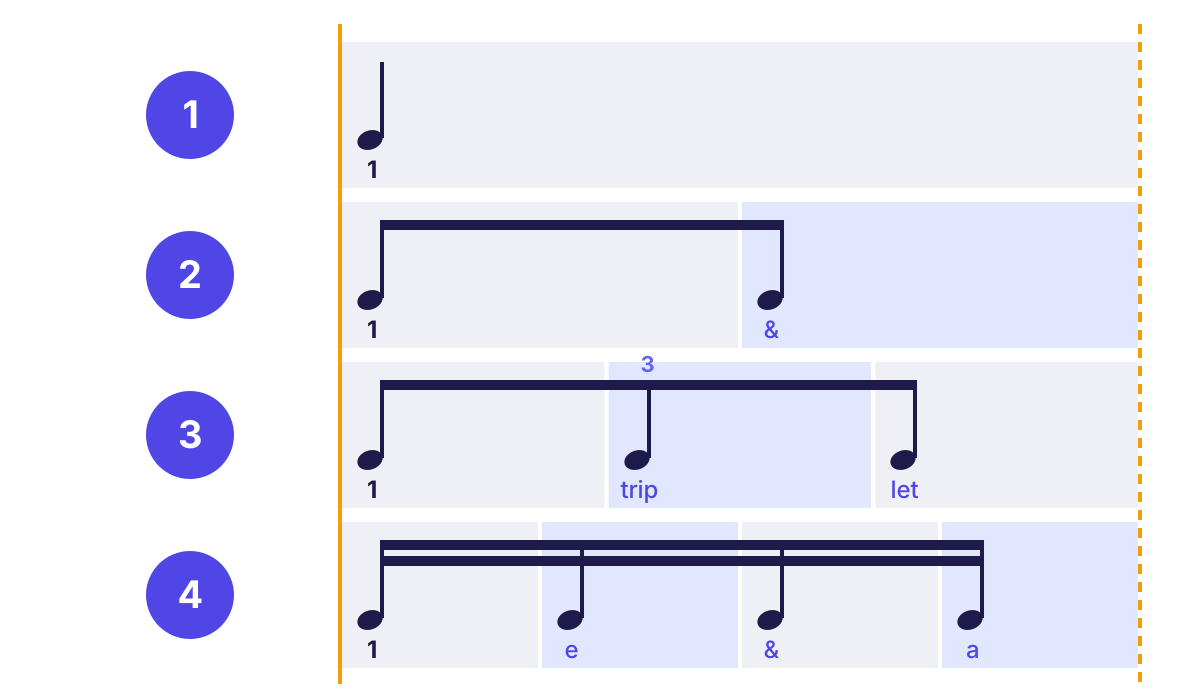
Some teachers use "1 la li" or "1 & a" for triplets, and that's fine. What matters is that you keep the beat numbers separate from the subdivision syllables. Numbers always land on the beat; "e," "&," "a," "trip" and "let" always land between beats. That makes it instantly clear that any note starting on "&" is an off-beat.
Count the rests, too. Dropping the count during rests is one of the most common ways timing falls apart. Whisper the counts that fall on rests, or say them in your head as if in parentheses: "1 (&) 2 &."
Metronome practice: a five-stage routine
The metronome is the basic tool of rhythm practice, but if you just turn it on and play along, you tend to end up chasing the click. The real goal of metronome practice isn't to match the click. It's to keep the same time when the click isn't there. Work through these stages in order.
- Start at a tempo you can't get wrong Find the tempo where you can play the passage three times in a row without a mistake. That's usually around 60–70% of your target. If you're aiming for 100 BPM, start at 60–70. At this stage, try to line up so well with the click that it seems to disappear under your notes.
- Raise the tempo 5–10% at a time After three clean reps in a row, bump the tempo up 5–10% (about 3–6 BPM at 60). If you make a mistake, drop back to the previous tempo. Instead of forcing a 20 BPM jump in one session, start the next day a little below where you finished. Progress sticks better that way.
- Put the click on 2 and 4 Set the metronome to half your target tempo (100 BPM becomes 50) and hear each click as beats 2 and 4. Now you have to supply beats 1 and 3 yourself, which strengthens your internal pulse. It's also where the snare drum lands in most pop, rock and jazz, so you're building groove at the same time.
- Put the click on beat 1 only In 4/4, set the metronome to a quarter of your tempo (100 BPM becomes 25) so it only clicks on the downbeat of each bar. You now have to hold three beats on your own between clicks, which is a big step up. Check that you land squarely on the click at the top of every bar.
- Gap practice: take the click away Play four bars with the click and four bars without, and see whether you're still together when the click comes back. Many metronome apps have a "muted bars" or "gap" setting; if yours doesn't, just turn the volume down and back up. Once that's comfortable, stretch the silent section: two on/two off, then four on/eight off.
One rule runs through every stage: slow and accurate always beats fast and sloppy. Slow tempos look easy, but the long gaps between beats actually make the pulse harder to hold. If you can stay rock-steady at 50–60 BPM, stability at faster tempos tends to follow.
Subdivision practice: from quarter notes to sixteenths
Once your pulse feels reasonably steady, it's time to divide the beat. The most effective subdivision practice keeps the tempo fixed and changes only how many notes you play per beat. Leave the metronome clicking quarter notes and work through the table below, clapping or playing a single note on your instrument.
| Stage | Notes per beat | Count | Suggested starting BPM | Pass when… |
|---|---|---|---|---|
| 1. Quarter notes | 1 | 1 2 3 4 | 60–80 | Your claps cover the click completely |
| 2. Eighth notes | 2 | 1 & 2 & | 60–70 | Every "&" sits exactly halfway between clicks |
| 3. Eighth-note triplets | 3 | 1 trip-let | 50–60 | Three even notes, first one on the click |
| 4. Sixteenth notes | 4 | 1 e & a | 50–60 | Four even notes; the "&" matches the eighth-note spot |
| 5. Switching | 1→2→3→4→3→2→1 | One bar of each | 50–60 | The beat doesn't move when the subdivision changes |
Stage 5 is the one that pays off most, because real music mixes subdivisions constantly: eighth notes, then a triplet, then a run of sixteenths. Most players speed up when they switch to sixteenths and slow down when they return to quarter notes. Record yourself doing the ladder and you'll hear your own habits right away.
If triplets give you trouble
Triplets are the least familiar subdivision for ears used to dividing by two and four. Alternate one bar of eighth notes ("1 &") with one bar of triplets ("1 trip-let") and feel the difference. The second triplet note comes noticeably earlier than the "&," and the third comes noticeably later. Accenting each beat makes the groups of three snap into focus.
Off-beats, syncopation, ties and dotted rhythms
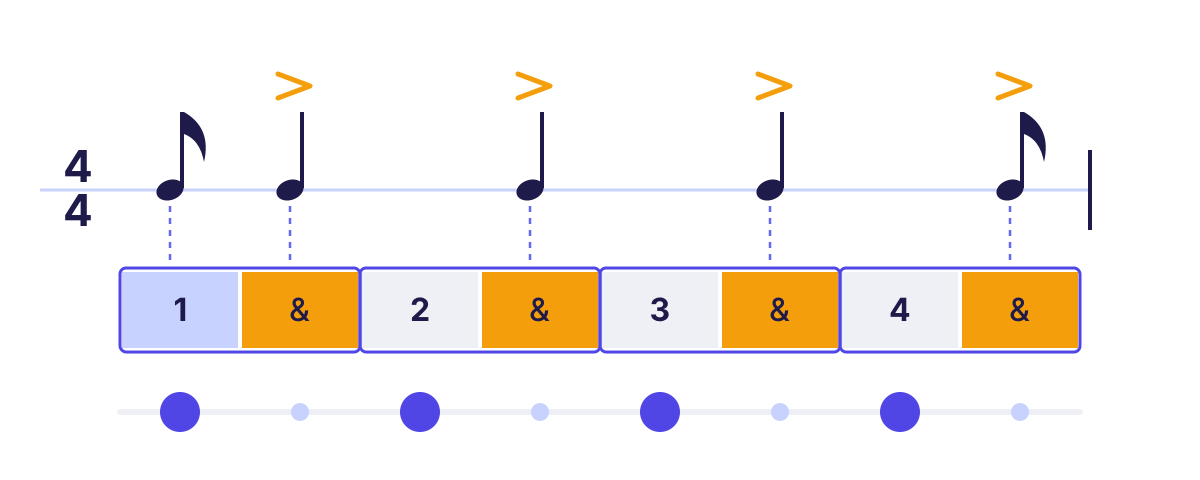
An off-beat note starts between beats, on an "&" or an "e" or "a," instead of on the beat itself. Syncopation goes one step further: the accent shifts to a weak beat or an off-beat, so notes seem to arrive early. Most popular music is built on it, which means off-beat practice isn't optional if you want to play with other people.
Three rules that keep syncopation from falling apart
- Your foot owns the beat. Keep tapping 1, 2, 3, 4 with your foot, as in the diagram, and let your hands fill in between. If your foot starts following the off-beat notes, the whole bar slides half a beat.
- Count every subdivision out loud. Say the full "1 & 2 &" and speak louder only where a note falls. With syncopation, it's easy to lose track of where a note ends; keeping the count going tells you exactly when the next beat arrives.
- Fill it in, then take notes away. Play the rhythm first as straight eighth notes (1 & 2 & …), then drop notes one at a time until only the syncopated pattern is left. You never lose your place.
Reading ties and dotted notes
A dot adds half the note's value. A dotted quarter equals a quarter plus an eighth, so it covers "1 & 2," and the next note arrives on "2 &." A tie connects two notes of the same pitch into one longer sound, and it's how notation shows a note that crosses a beat. A note that starts on "&" and holds into the next beat, for example, is usually written as an eighth tied to a quarter.
The reading strategy is the same for both: don't play the second note of a tie, but do count it, and break dotted notes into eighths (or sixteenths) while counting. A good way in is to play every note first, ignoring the tie, then go back and silence just the tied note. If the symbols themselves are still new, read our guide to reading sheet music first.
Learn it in your body, then check it with recordings
Your body remembers rhythm before your brain does. Learning a rhythm physically before you pick up the instrument lets you separate the timing problem from the finger problem, which makes practice far more efficient.
Foot taps, clapping and speaking the rhythm
- Tap the beat with your foot. Sitting down, tap quarter notes with your heel or toe. Keep it going while you play if you can. On piano, where your feet may be busy with the pedal, a small head nod works too.
- Clap the rhythm. Keep the beat in your foot and clap the written rhythm with your hands. Once your hands and feet are comfortable doing different things, off-beats get much easier.
- Speak it. Say the rhythm with syllables ("ta, ti-ti, ta-a") or with the counts. If you can't say a rhythm accurately, you won't play it accurately.
- Count while you walk. Treat each step as a quarter note and count eighths, triplets or sixteenths over it. It turns any walk into subdivision practice.
Record yourself
It's hard to judge your own timing while you're playing. Record with your phone, metronome included, and when you listen back, ignore everything except one question: do my notes line up with the click? If you hear your note before the click, you're rushing; after it, you're dragging. Record the same passage a week apart and you'll be able to hear your progress.
Use Rhythm Helper to hear the correct rhythm first
A metronome gives you the beat, but it can't tell you what a written rhythm should sound like. When you hit a bar you can't hear in your head, say a mix of dotted notes and ties, or a triplet followed by a syncopation, try Rhythm Helper. Set the tempo and time signature, enter the notes, rests, dotted notes, ties and triplets exactly as written, and it plays that rhythm back with a click while highlighting the note you should be playing.
Here's a workflow that works well: (1) enter the tricky bar and play it back slowly, just listening; (2) play it again and clap along with the highlight; (3) close the app, turn on a plain metronome, and play the rhythm on your instrument. The free version runs in a web browser with no install and handles two bars, which is just right for drilling one hard spot. Pro extends that to 32 bars and lets you enter separate left- and right-hand rhythms. It doesn't record or grade your playing, so keep using your phone recordings to check yourself.
Applying rhythm practice to piano, guitar and band rehearsal
Piano
On piano, the two hands often play different rhythms, which makes timing easy to lose. Practice each hand alone with the metronome first, and when you put them together, drop the tempo to around half your target. If the left hand plays on the beat while the right hand plays off-beats, think of the left hand as your "foot." Tapping the rhythm with both hands on a tabletop is a surprisingly useful exercise. If you're just starting out, pair this with the routine in our beginner's guide to teaching yourself piano.
Guitar
The secret to steady strumming is never stopping your strumming hand. For eighth-note rhythms, keep the hand moving down on the beat and up on the "&," and on the strokes you don't want to sound, swing past the strings without hitting them. Your hand becomes the metronome, and off-beat strums fall into place. For sixteenth-note patterns, map down-up-down-up onto "1 e & a." We go through specific patterns in guitar strumming rhythm practice.
Band and ensemble
In a group, locking in with other players matters as much as being accurate on your own. Use the drummer's hi-hat (the subdivision) and snare (beats 2 and 4) as your reference, and listen for where the bass and kick drum meet. If you've done the click-on-2-and-4 exercise at home, locking in with a drummer gets much easier. Another good habit: agree on a BPM for the hard sections and have everyone practice them at that tempo before rehearsal. For more on group work, see how to run a productive band rehearsal.
A 4-week rhythm practice plan and common mistakes
Fifteen to twenty minutes a day is enough. Showing up every day for a short session does more than one long session a week. These rhythm exercises for musicians work on any instrument, or just with your hands.
| Week | Focus | Daily routine (15–20 min) | End-of-week check |
|---|---|---|---|
| 1 | Pulse and counting | Clap quarter notes at 60, 80 and 100 BPM, 2 min each / count eighth notes aloud, 5 min / read rhythms with rests, 5 min | At 60 BPM, cover the click for a full minute |
| 2 | Subdivision ladder | Quarter → eighth → triplet → sixteenth switching, 8 min / click on 2 and 4, 5 min / record and review, 3 min | Run 1→2→3→4→3→2→1 at 60 BPM without the beat moving |
| 3 | Off-beats, dots and ties | Foot on the beat + clapped off-beats, 5 min / read dotted-quarter and tied rhythms, 5 min / drill two hard bars from a piece, 8 min | Four bars of syncopation with the foot steady throughout |
| 4 | Internal clock + real music | Click on beat 1 only, 5 min / gap practice (4 on / 4 off), 5 min / apply to a piece, 10 min | Land with the click after four silent bars; compare to your week-1 recording |
Common rhythm practice mistakes
- Stopping to fix every mistake. The beat keeps going even when you miss a note. Practice letting wrong notes go and coming in on the next beat; on stage and in rehearsal, you can't stop.
- Living at your comfortable tempo. If you only play where it's easy, you plateau. Follow the rule: three clean reps, then 5–10% faster.
- Speeding up too soon. The flip side: raising the tempo before you've nailed three in a row teaches your hands the wrong timing.
- Cutting rests and long notes short. Rushing out of rests, dotted notes and ties is the single most common timing mistake. Count every long value to the end.
- Chasing the click. If you wait to hear the click and then react, you'll always be slightly late. Anticipate it and arrive together. The 2-and-4 and gap exercises fix exactly this.
Rhythm practice isn't glamorous, but steady time is the kind of fundamental that carries over to every instrument and every song you'll ever play. Start today with two minutes of quarter-note claps at 60 BPM.
Frequently asked questions
Can you learn rhythm if you have no rhythm?
Most people can. If you can clap along to a song even roughly, you already perceive the beat; what you need is practice holding it steady and dividing it evenly. A few weeks of counting out loud, staged metronome work and recording yourself usually makes a clear difference.
What tempo should I start metronome practice at?
Start at the tempo where you can play the passage three times in a row without a mistake, usually 60–70% of your target, or around 60 BPM for basic rhythm exercises. After three clean reps, raise it 5–10%; if you slip, go back one step.
How long should I practice rhythm each day?
Fifteen to twenty minutes a day is plenty. Short daily sessions build timing better than one long session a week. Adding 5–10 minutes of rhythm work as a warm-up before regular practice also works well.
How do I play triplets evenly?
Count "1 trip-let" or a three-syllable word like "pine-ap-ple" with equal stress, making sure the first syllable lands exactly on the beat. Alternating one bar of eighth notes with one bar of triplets trains your ear to hear the difference so the triplets don't get squashed.
Why do I rush or drag on off-beats?
Usually because the internal beat disappears when the notes stop landing on it. Keep tapping the beat with your foot, count every subdivision aloud, and practice the rhythm as straight eighth notes before removing notes. Putting the metronome on beats 2 and 4 also helps.
Can I practice rhythm without a metronome?
Yes. Foot tapping, clapping, speaking rhythms and counting while walking need no tools. To check whether your tempo is drifting, though, you'll want a metronome or a recording. If you're unsure how a written rhythm should sound, a tool like Rhythm Helper that plays back the exact rhythm you enter can help you hear it first.