
Guitar Strumming Patterns and Rhythm Practice: How to Strum in Time
Learn guitar strumming patterns that stay in time: the never-stopping strum hand, Old Faithful D-DU-UDU, 16th note strumming, and a metronome BPM plan.

If you know your chords but your playing still sounds stiff when you strum along to a song, the missing piece is almost always guitar rhythm practice. Listeners forgive a buzzy chord long before they forgive a wobbly beat. This guide covers the guitar strumming patterns that show up in most pop, folk and rock songs — from straight eighths and the famous "Old Faithful" pattern to 16th note strumming, shuffle feel and waltz time — and, more importantly, the one mechanical habit that makes all of them stay in time. You'll also get a metronome plan with concrete BPM targets and a checklist for the moments when your rhythm falls apart.
If you're brand new to the instrument, you may want to skim our guitar self-study guide first for chord basics and a daily routine. Everything here assumes you can switch between two or three open chords, even slowly.
How to strum in time: the right hand never stops
Most beginners learn a strumming pattern as a string of sounds: "down, down-up, up-down-up." The trouble with that approach is that every gap in the pattern becomes a moment where the hand stops — and every time it restarts, it lands a little early or a little late. Good rhythm players think about it the other way around. The strumming hand moves up and down continuously, like a pendulum, and you only decide whether the pick touches the strings.
Downstrums on the beat, upstrums on the "and"
When you strum in eighth notes, the rule is simple. Your hand travels down on every beat (1, 2, 3, 4) and up on every "and" between them. Follow that rule and the direction of your hand tells you exactly where you are in the bar. Break it — hitting a beat with an upstrum, or an "and" with a downstrum — and patterns start to tangle the moment they get even slightly syncopated.
Ghost strums (missed strokes) are what keep you in time
On the counts where a pattern is silent, your hand still makes the same motion but passes just above the strings. These are called ghost strums, missed strums or "air strums." A ghost strum isn't a rest for your hand; it's the ruler that measures where the next real strum belongs. In the beginning it's fine if you accidentally brush the strings on a ghost — keeping the motion unbroken matters far more than keeping it silent.
Counting rhythm and reading strumming notation
Strumming patterns are usually written with D and U or with ↓ and ↑ arrows. The weakness of writing "D DU UDU" is that you can't see where the gaps fall. So throughout this guide, patterns sit on top of a count grid:
- Eighth notes: 1 & 2 & 3 & 4 & — eight slots per bar of 4/4; numbers are downs, "&"s are ups.
- Sixteenth notes: 1 e & a 2 e & a … — sixteen slots per bar; your hand moves twice as often.
- Triplet feel: each beat splits into three, counted "1 trip-let 2 trip-let."
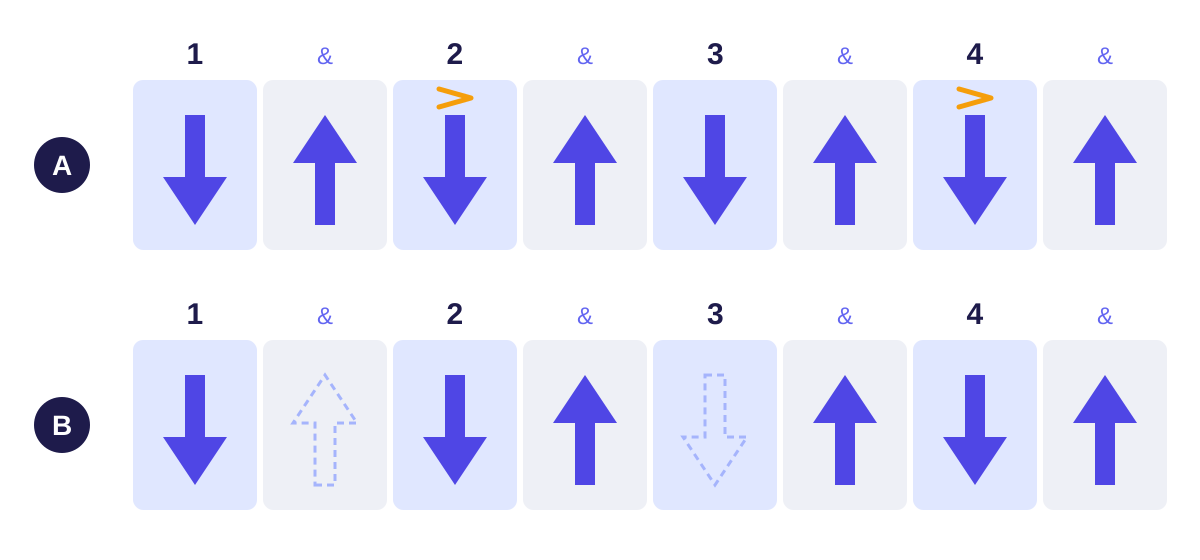
Once the Old Faithful pattern sits on a grid (row B), you can see immediately that the up after beat 1 and the down on beat 3 are ghosts. Counting out loud with the ghost slots whispered — "ONE (and) TWO and (three) and FOUR and" — is one of the fastest ways to lock it in. If note values and time signatures still feel foreign, our guide on how to read sheet music covers the basics.
Strumming patterns for beginners and beyond
The table below lists patterns that cover the vast majority of song accompaniment. Parentheses mark ghost strums and bold marks accents. Names vary between teachers, so learn each pattern by its count and hand direction rather than by its label.
| Pattern | Count | D/U notation | Fits genres |
|---|---|---|---|
| Straight eighths | 1 & 2 & 3 & 4 & | D U D U D U D U | Rock, punk, up-tempo pop |
| Folk eighths | 1 (&) 2 & 3 (&) 4 & | D (u) D U D (u) D U | Folk, mid-tempo pop |
| Old Faithful | 1 (&) 2 & (3) & 4 & | D (u) D U (d) U D U | Acoustic pop, folk, campfire songs, worship |
| Old Faithful in 16ths | 1 (e) & a (2) e & a | D (u) D U (d) U D U ×2 | Ballads, slow acoustic pop |
| 16th-note funk | 1 e & a 2 e & a … | D U D U X U D U … | Funk, disco, R&B |
| Shuffle | 1 (trip) let 2 (trip) let … | D U D U (long-short) | Blues, country, early rock 'n' roll |
| 3/4 waltz | 1 (&) 2 & 3 & | D (u) D U D U | Waltzes, folk ballads in three |
| 6/8 | 1 (&) 2 & 3 (&) 4 (&) 5 & 6 (&) | D DU D · D DU D | 6/8 ballads, power ballads |
Straight eighths: where every pattern starts
Eight even strums per bar, alternating down and up. It sounds trivial, but getting the ups and downs to roughly the same volume, then leaning into beats 2 and 4 for a backbeat, already gives you a solid rock rhythm part. On upstrums don't try to hit all six strings — brushing the top three or four is enough and keeps the sound light.
The Old Faithful pattern (D-DU-UDU)
If you've watched a few beginner guitar lessons, you've met this one. It's sometimes called "Old Faithful" or the "universal strumming pattern" because it fits an enormous number of acoustic songs. The hand keeps moving in eighths and simply skips two strokes: the up after beat 1 and the down on beat 3. Skipping beat 3 means the upstrum on 2-and rings through where you'd expect a strong beat — that's syncopation, and it's what gives the pattern its lift. Hit beat 3 by accident and it collapses into plain eighths, so the beat-3 ghost is the stroke to practice most carefully.
16th note strumming
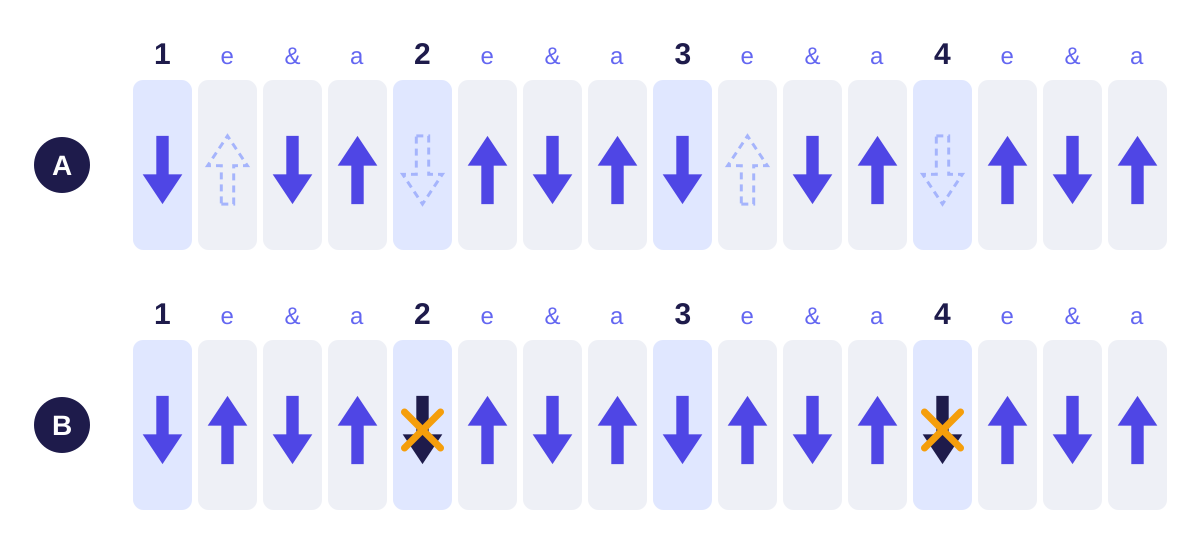
In 16th note strumming the hand moves four times per beat: down-up-down-up. The principle doesn't change: the number and the "&" (first and third slots of each beat) are downs, the "e" and "a" (second and fourth slots) are ups. A very common ballad move is to compress Old Faithful into sixteenths so it repeats every two beats. Your hand doubles its subdivision, but because the tempo is slower, its actual speed is about the same — 16ths at 60 BPM move your hand exactly as fast as eighths at 120 BPM.
Shuffle: long-short
A shuffle sits on a triplet grid. You strum down on the first triplet of each beat and up on the third, ghosting the middle one, which produces the lopsided "daah-da daah-da" feel of blues and early rock. Strum it evenly and the shuffle disappears, so count "1 trip-let 2 trip-let" out loud and let the down stroke take noticeably longer than the up.
3/4 waltz and 6/8 strumming
A basic 3/4 pattern puts a bass note or a heavy downstrum on beat 1 and answers it with lighter D-U D-U on beats 2 and 3 — "boom, chick-a chick-a." In 6/8 there are six eighth notes per bar but only two big pulses, on 1 and 4. Start by strumming all six eighths as downstrums with accents on 1 and 4. Once that feels natural, let your hand move in sixteenths and play "D DU D · D DU D." The key is to feel 6/8 in two, not in six.
Muting, chopping and accents: giving rhythm a shape
The same pattern can sound completely different depending on how loud and how long each strum is. Most of what makes a rhythm player sound "good" comes from these details rather than from knowing more patterns.
- Fretting-hand mute (chop): relax the fingers holding the chord just enough to lift the strings off the frets and you get a percussive "chk." Placed on 2 and 4, it plays the role of a snare drum, as in row B of the 16th-note figure.
- Strumming-hand mute: right after a downstrum, drop the side of your palm onto the strings to cut the chord short. It's the staple sound of a lot of acoustic pop.
- Accents: hit the backbeat (2 and 4) or the syncopated strums a little harder. It's usually easier to play everything else one notch softer than to whack the accents.
- Note length: letting chords ring sounds smooth; cutting them short sounds punchy. Playing verses short and choruses ringing is a simple way to make a song's structure audible.
When you practice chops, don't obsess over a perfectly dead sound at first. Check that the mute lands exactly on the metronome's 2 and 4. A slightly ringing chop that's on time sounds far better than a perfectly muted one that's late.
Guitar rhythm exercises with a metronome: a BPM plan
Strumming practice succeeds or fails on evenness, not speed. Fifteen to twenty minutes a day following the steps below is plenty. For the general principles of practicing with a click, see our article on rhythm and timing practice.
- Just move the hand (2 min) Lay your fretting hand lightly across the strings to mute them and strum straight eighths, D U D U, at 60 BPM. You should hear only a percussive "chk-chk." Check that the motion comes mostly from the wrist, not the shoulder.
- Count out loud (3 min) Play the pattern you're learning while counting "ONE (and) TWO and…" with the ghost slots whispered. Hand and voice now keep time together.
- One chord, one pattern (5 min) Pick a comfortable chord like G or Em and repeat only the pattern. After three clean four-bar passes in a row, raise the tempo 4–5 BPM. After two failed attempts in a row, drop 10 BPM.
- Add chord changes (5 min) Alternate two chords every two bars, then every bar. Your strumming hand keeps moving through the change.
- Play along with a song (5 min) Put on the original or hum the melody and play one full verse with the same pattern. If you make a mistake, don't stop; rejoin on beat 1 of the next bar.
| Stage | BPM | What to practice | Move on when… |
|---|---|---|---|
| 1 | 60 | Straight eighths, muted, then on one chord | Three clean four-bar passes; ups and downs are even in volume |
| 2 | 60–70 | Old Faithful with ghost strums, one chord | Your hand never pauses on the beat-3 ghost |
| 3 | 70–90 | Old Faithful with a chord change every two bars | Beat 1 after each change isn't late |
| 4 | 60–70 | 16th-note patterns (same hand speed as eighths at 120–140) | The "e" and "a" upstrums sound even |
| 5 | Song tempo | A full song while singing | You get to the end without stopping, mistakes included |
Even after you reach your target tempo, spend the first five minutes of each session 10–20 BPM below it. At slow tempos the gaps between clicks are longer, so a habit of rushing or dragging is actually easier to hear.
Write your strumming pattern as rhythm and hear it
A metronome only tells you where the beats are. With a syncopated pattern like Old Faithful, that makes it hard to know whether what you're playing is actually right. Writing the pattern as rhythmic notation clears this up: each strum that sounds is the start of a note, and each ghost strum is just the previous note continuing.
- Old Faithful (4/4, eighth-note grid): quarter note (1) – eighth (2) – eighth (2&) tied to eighth (3) – eighth (3&) – eighth (4) – eighth (4&). The ghosted downstrum on beat 3 is the tie. Writing 2& as a quarter note gives the same duration.
- Old Faithful in 16ths (two beats): eighth (1) – sixteenth (&) – sixteenth (a) tied to sixteenth (2) – sixteenth (2e) – sixteenth (2&) – sixteenth (2a).
- Shuffle: each beat as a triplet grouping of a quarter plus an eighth.
That's exactly the kind of thing we built Rhythm Helper for. Enter the notes, rests and ties, drop the tempo to around 60 BPM, and it plays that rhythm back with a click on each note while highlighting the note you should be playing. Tied notes aren't re-clicked, so every click you hear is a moment when the pick should hit the strings. Strum along with the playback and you'll notice right away if your hand rushes through a ghost strum. To be clear about its limits: it plays rhythm only — it doesn't record or grade your guitar — so use your phone's recorder to check your own playing. The free version runs in a web browser and handles two bars, which is enough for a one- or two-bar strumming pattern.
Applying patterns to songs: keeping time through chord changes
The most common reason a pattern that works on its own falls apart in a real song is the chord change. The instant your strumming hand waits for your fretting hand to find the next shape, the bar stretches by half a beat — and the singer, or the band, doesn't wait.
Use the last upstrum as travel time
The upstrum on the final "&" of the bar only brushes a few treble strings, so it barely matters if your fretting hand has already left the old chord. Experienced players do this constantly. Don't worry about a few open strings ringing on that last upstrum; put all your attention on landing the downstrum on beat 1 of the next bar.
When the change is still too hard
- Simplify only the bar with the change — for example, play four plain downstrums in that bar and Old Faithful everywhere else.
- Mark the spots where the chord changes on a strong beat and set one goal: never miss that downstrum.
- If singing and strumming at once is too much, speak the lyrics or hum first. Hand-voice independence only comes from repetition.
If you get the chance to play with other people, locking in with a drummer or bassist will grow your sense of time faster than almost anything else. Our band rehearsal guide has tips on staying together.
When your rhythm falls apart: checklist and common mistakes
If your timing keeps slipping, work through this list. Usually one or two items are responsible.
- Does your hand stop on ghost strums? Watch in a mirror or film your hand. If it pauses, go back to muted strings and pure hand motion.
- Are your upstrums too heavy? When ups are as loud as downs, the groove limps. Keep upstrums light and mostly on the treble strings.
- Are you gripping the pick too hard? A pick that catches on the strings makes your hand hesitate. Let only 2–3 mm of the tip show; a thin pick (around 0.5–0.7 mm) makes strumming smoother while you learn.
- Are you strumming from the shoulder? Big arm motions can't keep up at faster tempos. Let the wrist do most of the work, with the elbow helping.
- Can you actually hear the click? If the guitar drowns out the metronome, the practice loses its point. Use headphones or turn the click up.
- Do you stop and restart after every mistake? That habit is exactly what makes you drop beats when accompanying. Practice recovering on the next beat 1 instead.
Other habits worth catching: digging the pick too deep into the strings, which makes the tone harsh; slamming the low E string on every downstrum, which muddies the chord; and speeding up every time you switch patterns between sections. Record yourself — these habits are hard to notice while playing and obvious on playback.
Frequently asked questions
How many strumming patterns does a beginner need to know?
Three will carry you through most pop and folk songs: straight eighths, Old Faithful (D-DU-UDU) and a basic 3/4 waltz pattern. Add a 16th-note pattern and a shuffle and you can handle ballads and blues as well. Being able to play one pattern steadily while singing matters more than knowing many.
Why can't I get the D-DU-UDU strumming pattern right?
Almost always the hand either stops or accidentally hits the strings on beat 3. At 60 BPM, count "ONE (and) TWO and (three) and FOUR and" with the ghost slots whispered, and repeat the motion on muted strings first. Once the motion is continuous, play it on a chord the same way.
Why do I keep speeding up when I strum?
Usually because the silent ghost-strum slots get shortened, or because you rush to get through a hard chord change. Record yourself with a metronome to find where it happens, then loop that spot 10 BPM slower.
When should I start practicing 16th note strumming?
Once you can play straight eighths and Old Faithful steadily at 80–90 BPM including chord changes. Start 16ths at around 60 BPM — your hand is already moving as fast as eighths at 120, so there's no need to start faster.
Can I practice guitar rhythm with an app instead of a metronome?
A metronome gives you only the beat. If you enter a strumming pattern as notes in a rhythm app like Rhythm Helper, it plays that exact rhythm back with clicks and highlighting, which helps you learn syncopated patterns by ear. It doesn't handle pitch or record and grade your playing, so check your own strumming with a recording.