How to Learn Piano by Yourself: A 6-Month Roadmap for Adult Beginners
Want to learn piano by yourself as an adult? Follow this step-by-step plan: gear, posture, finding C, five-finger position, rhythm practice, a 25-minute daily routine, and a 6-month roadmap.
Plenty of adults sit down at a keyboard and wonder whether it's too late, or whether it's even possible to learn piano by yourself. It is. Teaching yourself piano is a realistic goal for an adult beginner, as long as you replace the things a teacher normally provides: someone watching your posture and hand shape, and someone keeping your timing honest. This guide is a practical roadmap for your first six months. It covers what to buy, how to sit, how to find C on the keyboard, the five-finger position, the basics of reading music and counting, a 25-minute daily piano practice routine, and month-by-month goals you can actually check off.
Can you really teach yourself piano as an adult?
Adults may not pick up finger dexterity as quickly as kids, but they have real advantages: they can plan, they understand why an exercise matters, and they can stick to a routine once it makes sense. Add today's method books, videos, and apps, and self-taught piano for beginners is far more approachable than it used to be.
What's great about learning on your own
- Your schedule, your budget. Twenty minutes after work or half an hour on a Saturday morning both count.
- Music you actually want to play. You can aim for an easy arrangement of a song you love, which is a powerful motivator.
- Your pace. Skip ahead when something clicks, and stay on a tricky page for a few extra days when it doesn't.
The real downsides (and how to handle them)
- Nobody flags bad habits. Collapsed wrists and tense shoulders creep in unnoticed. Fix: once a week, film yourself from the side and from above and compare against the posture checklist below.
- Timing drifts. Nearly every self-taught player slows down on hard bars and rushes the easy ones. Fix: keep an external reference, such as a metronome or a rhythm tool, instead of trusting your internal clock.
- No plan, no progress. Replaying the same three songs gets boring fast. Fix: follow a roadmap with clear checkpoints, like the one later in this article.
In short, success comes down to feedback and structure more than talent. If you hit a wall around month three, booking one or two one-off lessons just to check your posture and hand position can be money well spent, and you can keep going on your own afterward.
What you need to start learning piano on your own
You don't need everything on day one. Here's how to prioritize.
| Item | What to look for | Priority |
|---|---|---|
| Keyboard instrument | Ideally an 88-key digital piano with weighted (hammer-action) keys. On a tight budget, a 61-key keyboard with touch-sensitive keys can get you through the first months | Must-have |
| Bench or adjustable seat | Height-adjustable. Dining chairs are usually the wrong height | Must-have |
| One method book | An adult method such as Alfred's Adult All-in-One or Faber Adult Piano Adventures. Pick one and work through it in order | Must-have |
| Metronome | A free phone app or your digital piano's built-in metronome is fine | Must-have |
| Headphones | Wired headphones (less latency) if you practice late at night | Nice to have |
| Sustain pedal | You won't need it until month two or three; the one bundled with most digital pianos is fine | Later |
Practicing for a long time on very light, non-weighted keys can make an acoustic piano feel heavy later, so lean toward weighted keys if you can. For help choosing an instrument, see how to choose a digital piano, and if you're torn between books, our piano method books guide compares the popular options.
Piano basics, step 1: posture and hand shape
Posture is far easier to set up in week one than to fix in month six. Run through this 30-second check every time you sit down.
- Center yourself. Sit facing the middle of the keyboard (usually near the brand logo). With your arms stretched forward, your fists should reach roughly to the fallboard.
- Set the height. With your hands on the keys, your elbows should be level with the keys or slightly above, and your forearms roughly parallel to the floor.
- Sit on the front half of the bench. Keep both feet flat on the floor. Sit tall without stiffening your back.
- Shape your hand. Let your hand drop onto your knee and notice its natural, rounded curve. Keep that shape on the keys, fingers gently curved, playing on the pads just behind the fingertips.
- Release tension. Shrug your shoulders up and let them drop. Keep your wrist level with your forearm, neither sagging nor bent upward.
Finding your way around the keyboard: C and the five-finger position
How to find C
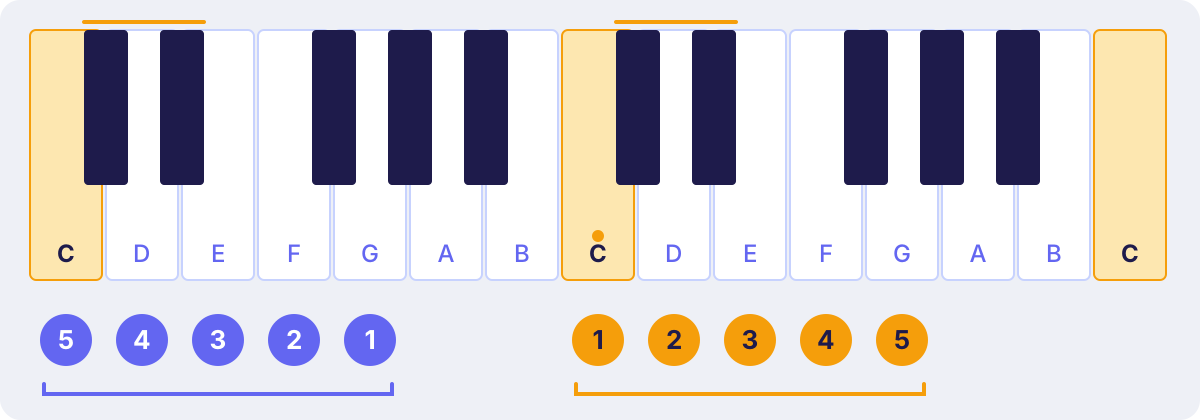
The black keys come in alternating groups of two and groups of three. The white key just to the left of any group of two black keys is C. Moving right from there you get D, E, F, G, A, B, and then C again. An 88-key piano has eight Cs; the fourth one from the left is Middle C, the landmark most beginner books start from.
Learn your finger numbers
On both hands, thumb = 1, index = 2, middle = 3, ring = 4, pinky = 5. Those small numbers above and below the notes in your book are fingerings, and following them is the easiest way to avoid running out of fingers mid-phrase. A quick drill: rest your hands on a table, call out a number, and lift only that finger. One minute a day is enough.
Five-finger position exercises
Put your right thumb on Middle C and fingers 1-2-3-4-5 land on C-D-E-F-G. For the left hand, put your pinky on the C an octave lower, and fingers 5-4-3-2-1 land on C-D-E-F-G. For roughly the first one to two months, most beginner pieces stay in a position like this without moving the hand.
- Up and down: play C-D-E-F-G-F-E-D-C in quarter notes at 60 BPM, ten times per hand.
- Even tone: fingers 4 and 5 tend to come out weaker. Listen for five notes at the same volume.
- Move it: once it feels easy, shift the same pattern to G position (G-A-B-C-D) and F position.
Reading music and rhythm practice: timing comes first
Self-taught players tend to obsess over note names and treat rhythm as an afterthought. But listeners forgive a wrong note almost instantly, while unsteady timing makes a whole piece feel shaky. For your first two months you only need to read Middle C up to G in the treble clef and the C-to-G an octave lower in the bass clef. Our guide on how to read sheet music walks through the staff, clefs, and note values in detail.
How to practice rhythm and counting
- Count out loud. In 4/4, say "one, two, three, four" as you play. When eighth notes show up, subdivide: "one-and-two-and."
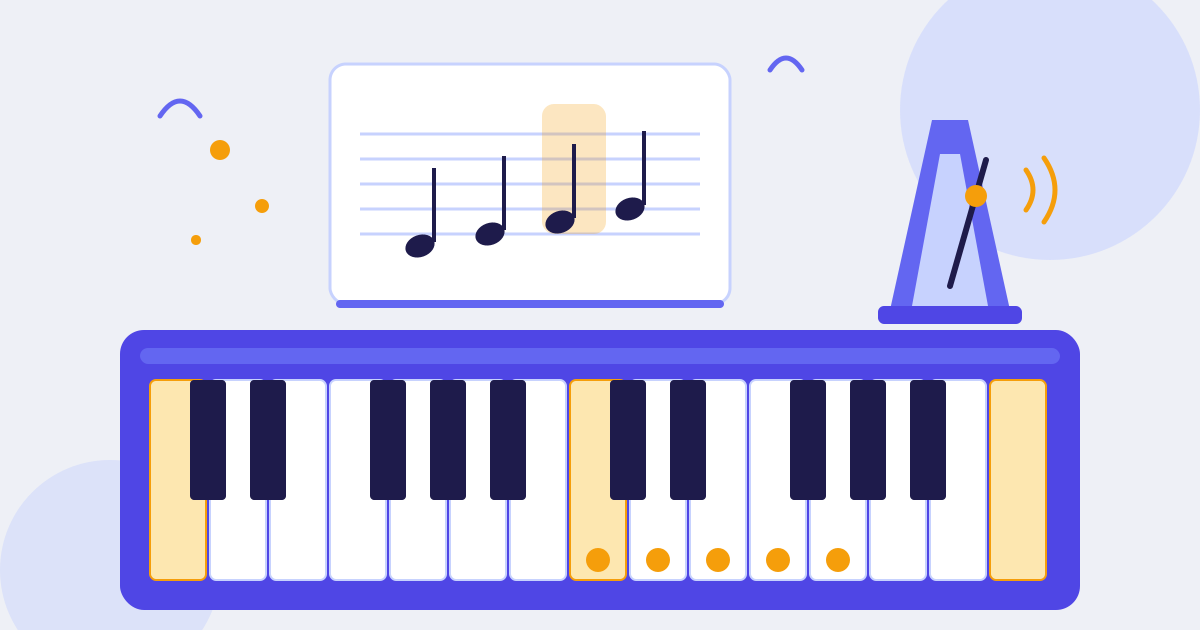
- Start slow on the metronome. Begin around 60 BPM. Only after you play a passage cleanly and in time three times in a row, nudge it up 4–5 BPM.
- Separate rhythm from notes. When a passage is hard, clap or tap the rhythm on your lap before touching the keys.
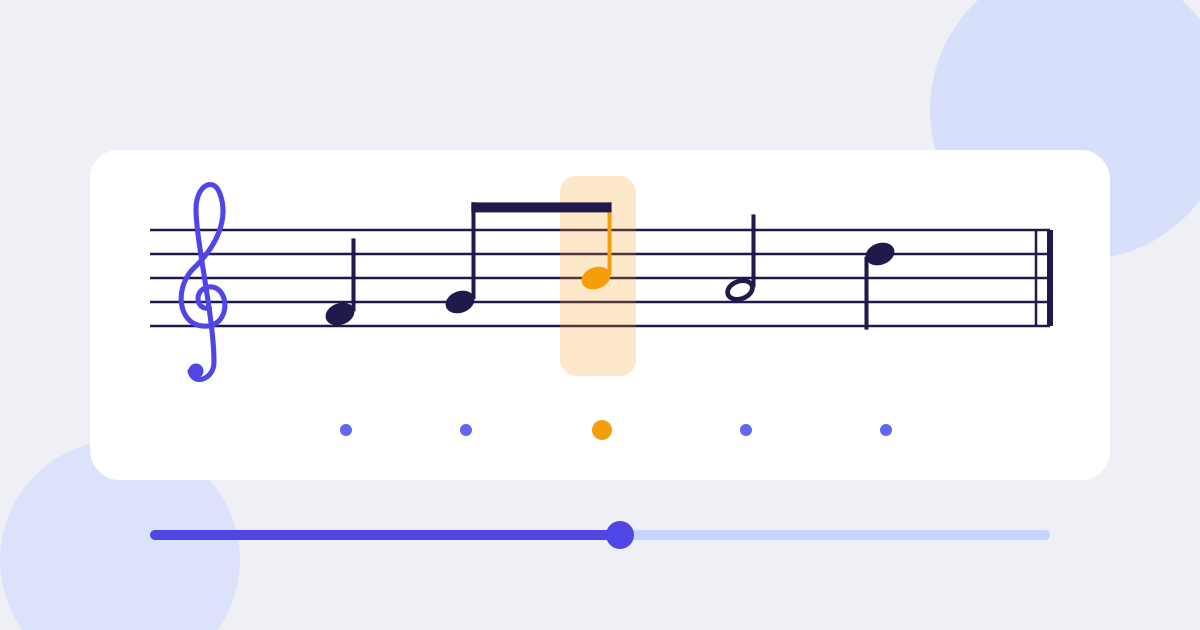
A metronome only gives you the steady beat. It can't tell you what a dotted rhythm or a tied note is supposed to sound like. This is where Rhythm Helper is useful: enter the rhythm from your book, notes and rests exactly as written, and play it back. Each note is highlighted as it sounds, with a click on every note, so you hear and see the correct rhythm before trying it on the keys. Listen a few times, follow along with your eyes, then play it. For a deeper dive, read our rhythm and timing practice guide.
A 25-minute daily piano practice routine
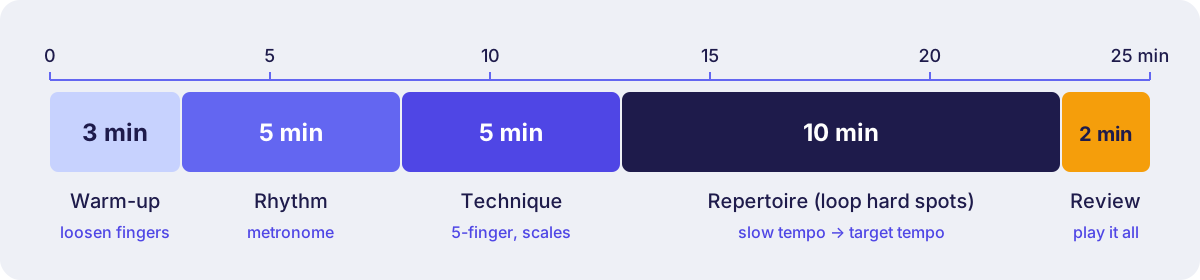
For most adults, "20–30 minutes every day" beats "two hours on Sunday." Spreading practice across shorter, frequent sessions is widely recommended for building motor skills, and more importantly, it's much easier to turn into a habit. Here's a piano practice routine built around 25 minutes.
| Time | Block | What to do |
|---|---|---|
| 0–3 min | Warm-up | Wrist circles, then five-finger position up and down, three times each hand |
| 3–8 min | Rhythm | Take today's trickiest rhythm: clap it, play it on one key, then play it with the metronome at 60 BPM |
| 8–13 min | Technique | Shift between five-finger positions; from month two or three, add a one-octave C major scale with the thumb crossing |
| 13–23 min | Repertoire | Work in 2–4 bar chunks. Hands separately, then together; slow tempo, then target tempo |
| 23–25 min | Review | Play the whole piece once without stopping, even if you make mistakes, and record it on your phone |
A 6-month roadmap for adult piano beginners
Everyone moves at a different speed, so treat these time frames as rough guides for someone practicing 20–30 minutes a day, at least five days a week. Move on when you pass the checkpoint, not when the calendar says so.
| When | Goals | Checkpoint |
|---|---|---|
| Weeks 1–2 | Posture, finger numbers, finding C, right-hand C position | You can find C with your eyes closed and play five even notes at 60 BPM |
| Weeks 3–4 | Left-hand C position, quarter/half/whole notes, one-hand melodies | You can play an 8-bar piece in 4/4 without stopping while counting out loud |
| Month 2 | Alternating hands, eighth notes, 3/4 time, rests | Right-hand melody with a simple one-note left-hand part at around 70 BPM |
| Month 3 | C major scale (thumb under), basic triads (C, F, G), dotted quarter notes | One-octave scale, hands separately, in eighth notes at 80 BPM |
| Months 4–5 | Changing hand positions, pedal basics, G and F major, ties and syncopation | You can finish an easy 16–24 bar piece with both hands |
| Month 6 | One easy arrangement of a song you love, dynamics (loud/soft) | You can play one piece start to finish for a friend or family member |
If you've reached that point at six months, you're through the beginner stage. Next up are harmony, accompaniment patterns, and longer pieces, which we cover in the intermediate self-taught piano guide.
Common mistakes and how to stay motivated
Traps self-taught beginners fall into
- Always starting from the top. If you mess up bar 9 every time and restart from bar 1, you mostly practice the easy part. Loop the problem bar plus one bar on each side instead.
- Playing too fast. Playing fast with mistakes trains the mistakes. Practice one notch slower than the fastest tempo you can play cleanly.
- Ignoring fingering. Grabbing whichever finger is convenient works for four bars and then falls apart. Pencil fingerings into the score for the first few run-throughs.
- Learning only from videos. Falling-note videos are fun, but if you put off reading music you'll need a new video for every new song. Keep the score in front of you even for easy pieces.
- Staring at your hands. In a fixed five-finger position you already know where every note is, so it's the perfect time to train your eyes to stay on the music.
Ways to keep going for the long haul
- Mix method-book pieces and "fun" pieces about 70/30. The book builds skills; songs you love keep you coming back.
- Record a monthly comparison. Record the same piece a month apart. Hearing the difference is hugely encouraging.
- Anchor practice to a fixed time. "Right after dinner" or "20 minutes before work" relies far less on willpower than "whenever I have time."
- Expect a plateau. Around months three to four, hand independence often feels stuck. Drop the tempo, go back to hands separately for a few days, and it usually passes.
Like practicing any instrument, how to practice piano comes down to slow, accurate, and daily. When a rhythm confuses you, use a tool like Rhythm Helper to hear the correct version first, then spend your time at the keyboard on sound and touch.
Frequently asked questions
Is it too late to learn piano as an adult?
No. There's no age limit on learning piano for fun. Adults may build finger dexterity a bit more slowly than kids, but they're better at planning practice and understanding why exercises matter, which makes short sessions efficient. Practicing 20–30 minutes consistently matters much more than the age you start.
How long should I practice piano each day as a beginner?
Aim for 20–30 minutes a day, at least five days a week. Short, frequent sessions are easier to keep up and reduce fatigue and injury risk compared with occasional long ones. On a busy day, even 15 minutes of warm-up, rhythm work, and one tricky passage keeps you moving.
Can I teach myself piano on a 61-key keyboard?
Yes, for the first three to six months. Five-finger positions and easy beginner pieces fit comfortably on 61 keys. Choose a keyboard with touch-sensitive keys so you can learn to control volume, and consider an 88-key digital piano with weighted keys as you progress.
Do I need to read sheet music to learn piano by myself?
You don't need to read fluently to start. Knowing a handful of notes around Middle C plus quarter, half, and whole notes is enough to begin a method book, and you add new notes as pieces introduce them. Learning only by imitating videos is fast at first but makes it hard to learn new songs independently, so build reading skills alongside.
What metronome tempo should a piano beginner start with?
Start around 60 BPM for quarter notes. Once you play a passage cleanly three times in a row, raise it by 4–5 BPM. If a rhythm is too complex to feel from the metronome alone, clap it first or play it back in a tool that sounds the exact rhythm, then move it to the keys.