How to Choose a Piano Method Book for Self-Study (Alfred vs Faber, Hanon, Czerny and More)
Looking for the best piano books for beginners? Learn how to choose a self-taught piano method, compare Alfred vs Faber, and see when Hanon, Czerny and Burgmüller fit in.
Search for the best piano books for beginners and you will get dozens of answers, most of them confidently different. Alfred, Faber, Hal Leonard, Hanon, Czerny, Burgmüller, "piano for adults" this and "complete course" that. If you are teaching yourself, the choice matters more than it does for a student with a teacher, because the book has to do the teacher's job too. This guide will not hand you a single winner. Instead, it shows you how to choose a piano method book: what separates a good self-study book from a frustrating one, how the different kinds of books fit together, where the classic titles belong, and how to move through a book without stalling.
One assumption up front: there is no universally best book. The same method can be perfect for someone who wants to play Chopin someday and a poor fit for someone who wants to accompany friends singing pop songs. If you are still finding middle C and learning what the lines on the staff mean, you may want to start with our beginner's guide to teaching yourself piano and come back here when you are ready to buy.
What makes a good self-taught piano book: a pre-purchase checklist
Many popular lesson books were designed to be used with a teacher who explains each new concept in person. That does not make them bad, but it means a book that works beautifully in a studio can leave a self-learner guessing. Before you buy, flip through the book in a store or use the online preview and check the following.
- Explanations are written out. When a new note, rhythm, key or fingering appears, the book should tell you what it is and why it matters. A book that is mostly pieces with very little text assumes someone else is doing the explaining.
- The difficulty climbs in small steps. Look for one new idea at a time. If you turn a page and suddenly both hands are moving fast in an unfamiliar key, that is where self-learners quit.
- There is a way to hear the right answer. Audio tracks, accompaniment files or publisher videos let you check yourself. Availability varies by edition and changes over time, so confirm what the current printing includes before you buy.
- Both hands and the bass clef show up early. Books that keep you in the treble clef with a right-hand melody for months tend to create a wall later, when the left hand has to read independently.
- Theory is tied to playing. Scales and chords stick when you use them in a piece on the same page, not when they sit in an appendix.
- The music is something you would actually want to play. A steady diet of exercises drains motivation. Check that there are familiar tunes or appealing short pieces.
- The engraving and binding are practical. Large, clear notation and a book that stays open on the music stand (spiral or lay-flat binding) make a real difference for beginners.
The five types of piano books (and why mixing them up causes trouble)
Most of the confusion comes from the fact that very different kinds of books sit on the same shelf. Once you sort them into five categories, it becomes much clearer what you actually need right now.
1. Traditional children's methods
These are the long-running lesson series built for kids, such as John Thompson's courses, Bastien, or the children's levels of Faber Piano Adventures and Alfred's Basic Piano Library. In Korea and Japan, Ferdinand Beyer's 19th-century primer fills this role. They are well sequenced and widely used, but the pacing, illustrations and song choices are aimed at young children, and they usually assume a teacher is present. An adult can use them, but will often find them slow.
2. Adult all-in-one methods
This is the category most adult self-learners should start with. An adult method combines note reading, rhythm, chords, basic theory and repertoire in one book, moves faster than children's series, and leans on recognizable songs. The big three in the US are Alfred's Adult All-in-One Course, Faber Adult Piano Adventures, and the Hal Leonard Adult Piano Method. We compare them in detail below.
3. Chord and accompaniment books
Instead of reading every note, these books teach you to read chord symbols (C, Am, G7) and turn them into left-hand patterns and accompaniment styles. They are the fastest route to playing along while someone sings, and they pair naturally with lead sheets and fake books. The trade-off is that they do not build classical sight-reading on their own.
4. Technique books
Hanon, Czerny etudes and scale books build finger independence, evenness and speed. They are a supplement, not a main course. Think of them as a short daily warm-up block, not the place where you spend most of your practice time.
5. Repertoire books
Collections of pieces to actually perform: Burgmüller's 25 Progressive Pieces, sonatina albums, graded classical anthologies, or easy arrangements of film and pop music. Repertoire is what keeps you going, so it is worth keeping one book at your level alongside your method. Difficulty labels like "easy piano" mean different things at different publishers, so always check the first page before buying.
Piano method books for adults: Alfred vs Faber vs Hal Leonard
"Alfred vs Faber" is one of the most common questions adult beginners ask, and the honest answer is that both are well established and either is a reasonable choice. The differences are mostly about teaching approach and taste. Here is a general picture of the three main adult series.
| Series | General approach | Often appreciated for | Things to check |
|---|---|---|---|
| Alfred's Adult All-in-One Course | Lesson, theory and technique combined; introduces chords and left-hand accompaniment patterns fairly early | Getting you playing recognizable songs with full-sounding chords quickly | Some learners find early reading leans on fixed hand positions; supplement with extra reading if so |
| Faber Adult Piano Adventures | Intervallic reading (reading by steps and skips) with chord theory woven in; a broad mix of styles | Clear explanations and a balanced blend of classical, folk, blues and pop-style pieces | The publisher has offered online support material for this series; confirm what is available for your edition |
| Hal Leonard Adult Piano Method | Steady, song-driven progression from a major popular-music publisher | Familiar tunes and editions packaged with audio | Compare a few preview pages with the others; pacing and layout preferences vary |
Alfred also publishes a separate Basic Adult Piano Course, which is a different series from the All-in-One, so check the exact title before ordering. All three series continue into a second book (and Alfred's into a third), which means you can stay with one method well past the absolute beginner stage.
If you cannot decide, read two or three sample pages of each. Pick the one whose writing style you understand without effort and whose song list makes you want to play. That will predict your success far better than any online ranking. Switching methods after Book 1 is also perfectly fine; the second method will feel like useful review.
Where Hanon, Czerny, Burgmüller and sonatinas fit
Beyond the adult methods, a handful of classic titles show up in nearly every discussion of self-taught piano books. You do not need all of them, but it helps to know what each one is for.
Hanon: The Virtuoso Pianist
Charles-Louis Hanon's book of finger exercises shifts one short pattern up and down the keyboard. The first part (roughly exercises 1 through 20) is what most people actually use. It can help with evenness and finger independence, but it is not musical in itself, and playing it fast for long stretches with a tense hand is a common way for self-taught players to strain their wrists and forearms. Keep it slow, relaxed and short.
Czerny etudes
Carl Czerny wrote a huge number of studies. The ones you will see most often are the Practical Method for Beginners (Op. 599), the 30 Studies of Mechanism (Op. 849), and the School of Velocity (Op. 299), roughly in that order of difficulty. Note that the numbers do not indicate level; in Korea and Japan these are called "Czerny 100, 30 and 40," which confuses everyone at first. Czerny builds solid technique, but a steady diet of it can feel dry, so pair it with real repertoire.
Burgmüller: 25 Easy and Progressive Studies, Op. 100
Each of these short pieces has a descriptive title and a distinct character, so they teach expression and phrasing while still working on technique. They are a favorite next step once you have finished the first book of an adult method, and they give self-learners the satisfying feeling of playing music rather than drills.
Sonatina albums
Collections of sonatinas by Clementi, Kuhlau and others introduce Classical-era style and the structure of sonata form in miniature. Clementi's Op. 36 sonatinas are a classic starting point. From there, the path usually leads to easier sonatas by Haydn, Mozart and Beethoven.
And what about Beyer? Ferdinand Beyer's Elementary Instruction Book for the Piano is the traditional first book in Korea and Japan but is rarely used in the US. It builds out slowly from a narrow range around middle C with a right-hand melody over a simple left hand. An American adult will usually get further, faster, with one of the adult methods above.
Choosing a path by goal: classical, pop accompaniment, or jazz
The most useful question when choosing books is simple: what do you want to be able to play a year from now? Two beginners with different answers should take different routes, even if they start at the same level.
| Goal | First 3–6 months | Next stage | Helpful alongside |
|---|---|---|---|
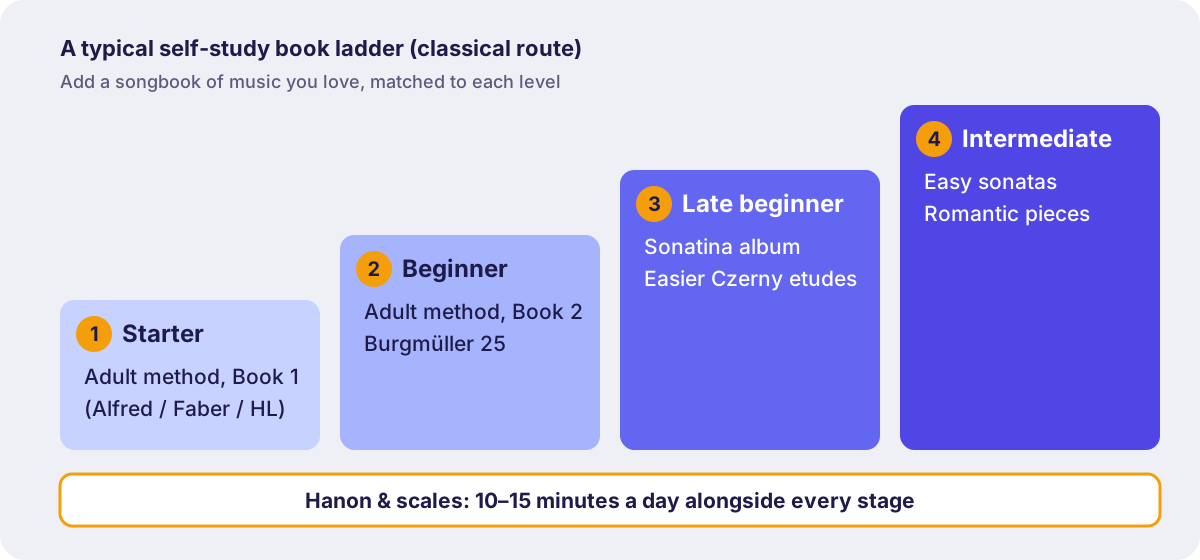
| Classical pieces from the score | Adult all-in-one, Book 1 | Book 2 → Burgmüller 25 → sonatina album → easy sonatas | Scales, the first part of Hanon, easier Czerny |
| Pop accompaniment and playing while singing | Adult all-in-one, Book 1 (for reading basics) | Chord and accompaniment method → arrangements of songs you love, lead sheets | A chord symbol chart, left-hand rhythm patterns |
| Getting started with jazz | Adult all-in-one, Books 1–2 (with chord theory) | An introductory jazz piano method (voicings, swing feel) → simple lead-sheet tunes | Scale and chord drills, lots of listening to swing |
Notice that all three routes start with a book that builds reading and basic hand position. Even if you only want to play chords or jazz, skipping basic reading makes every new song slower to learn later. Well-known jazz texts such as Mark Levine's The Jazz Piano Book are excellent but assume you can already read and know your chords, so treat them as a destination, not a starting point. If you are torn between styles, our comparison of classical vs jazz piano walks through how the two approaches differ.
Using your method book with apps and videos
The biggest weakness of any book is that it makes no sound. Recordings, videos and apps fill that gap well, as long as you use them in the right order: try reading it from the page first, then check with audio or video. If you start by copying the hands in a video, you can end up able to play a piece only by imitation and not from the score.
- Recordings and performance videos are best for getting the overall character and tempo. Use the publisher's audio first if your edition includes it.
- A metronome builds a steady pulse. Start slow and raise the tempo in small steps.
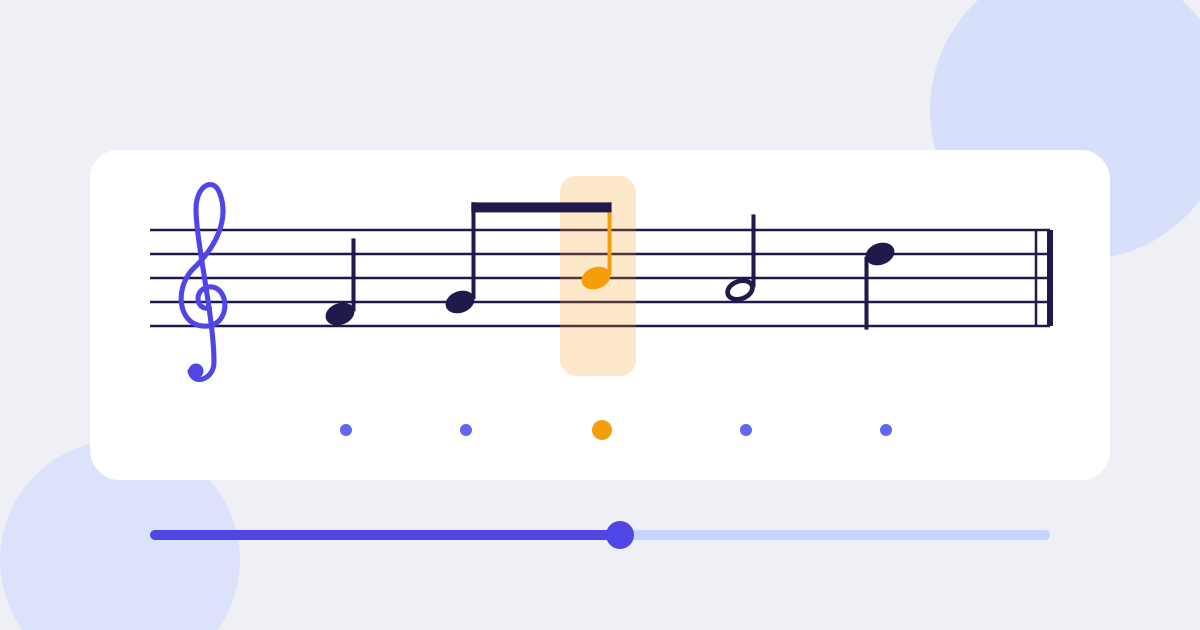
- A rhythm checker helps when a dotted rhythm, triplet, tie or 6/8 passage just does not click from the page. For example, you can enter the one or two problem bars into Rhythm Helper exactly as written; it draws them as notation, then plays that rhythm back with a click while highlighting the note you should be playing. It does not handle pitch, so use it to get the rhythm into your body first, then take it to the keyboard.
- Recording yourself on a phone reveals timing drift you cannot hear while playing.
For specific exercises that build steady timing, see our guide to rhythm and timing practice.
How to move through a method book: when is a piece "done"?
"When should I move on?" is one of the hardest questions for self-taught players, because no teacher is there to check off the page. Use the routine below for each new piece, and the final step as your finish line.
- Read the rhythm first. Before touching the keys, clap or speak the rhythm while counting out loud. Mark any bar that trips you up.
- Hands separately, slowly. Play each hand alone at a tempo slow enough that you do not make mistakes. Follow the printed fingering.
- Put hands together in small chunks. Combine hands two bars or one phrase at a time, and loop only the spots that break down.
- Play it through with a metronome. At a slow tempo, play from beginning to end without stopping. If you miss a note, keep the beat going.
- Raise the tempo gradually. Once it is clean, nudge the metronome up. Reaching around 70–80% of the marked tempo is fine at this stage of self-study.
- Apply the finish test. If you can play it at your target tempo, start to finish, without stopping, two or three times in a row, call it done and move on.
Staying on one piece for weeks until it is flawless usually slows you down. Moving on at around 80–90% and revisiting older pieces now and then builds skill more evenly. How long a piece takes depends on its length and on you, but if a short beginner piece has made no progress for several weeks, that is often a sign the book is ahead of your current level. When you reach the point of planning practice beyond the first books, our intermediate self-study guide picks up from there.
Common mistakes when choosing self-taught piano books
Starting with a book that is too hard
It is tempting to skip ahead to an intermediate anthology because "that is what I really want to play." If each page takes weeks, the sense of progress disappears and awkward hand habits set in. Starting slightly too easy is almost always faster in the long run.
Running several methods at once
Buying every book with good reviews and playing a few pages from each feels productive, but usually means you never finish any of them and stay at the same level. Pick one main method and experience getting to the end of it.
Living in technique books
Drilling Hanon and Czerny can make your fingers faster without making you better at playing actual music. Cap technique work at a fixed slice of each session (say 10 to 15 minutes) and spend the rest on pieces.
Choosing a route that does not match your goal
Spending years on classical etudes when what you wanted was to accompany singing, or learning only chords when you dreamed of playing Debussy, are both common detours. Check your direction against the goal table above.
Ignoring your instrument
Even the best book eventually stalls on a keyboard with too few keys or a very light, unweighted action. If your setup is holding you back, our guide on how to choose a digital piano covers what to look for.
In short, the right piano method book for adults is not the most famous one. It is the one that matches your goal and level and that you can understand on your own. Choose one main method, add a little technique and a book of music you love, finish each piece against a clear standard, and the books will lead you to the next step.
Frequently asked questions
What is the best piano book for adult beginners teaching themselves?
There is no single best book, but an adult all-in-one method is the most reliable starting point for self-study. Alfred's Adult All-in-One Course, Faber Adult Piano Adventures and the Hal Leonard Adult Piano Method are all well established. Preview a few pages of each and choose the one whose explanations and song selection suit you.
Alfred vs Faber: which is better for self-taught adults?
Both work well. In general, Alfred gets you playing chords and familiar songs early, while Faber emphasizes reading by intervals and a balanced mix of styles with clear explanations. The difference is mostly approach and taste, so compare sample pages rather than rankings.
Should I use Hanon as a beginner?
It is optional. If you use it, play only the first exercises, slowly and with a relaxed hand, for a short part of each session. Technique work should support your pieces, not replace them, and fast, tense repetition can cause strain.
How many piano books should I use at the same time?
About three: one main method, one technique book, and one repertoire or songbook at your level. Running several main methods at once usually means none of them gets finished.
How do I practice a rhythm in my method book that I can't figure out?
Count out loud and clap it before playing, then practice with a slow metronome. For dotted rhythms, triplets or 6/8 bars that still do not click, entering the rhythm into a playback tool like Rhythm Helper and listening to it with the notes highlighted can make it clear before you take it to the keys.
How long does it take to finish a piano method book?
It varies widely with practice time and the length of the book, so there is no fixed timeline. Judge progress piece by piece: can you play it at a set tempo from start to finish without stopping? If short pieces stall for weeks, consider a slightly easier book.