Intermediate Piano Self-Study: How to Get Better at Piano After the Beginner Stage
An intermediate piano self-study roadmap: a skills checklist, hand independence drills, scale BPM targets, accompaniment patterns, intermediate piano pieces, and when to get a teacher.
You finished your method book, you can play a handful of easy arrangements, and now you're staring at the piano wondering what comes next. That moment is where intermediate piano self-study really begins, and it works differently from the beginner stage. There's no single book that carries you through by turning pages. To move up, you need your hands to do different jobs at the same time, solid technical basics, a good eye for choosing pieces, and an ear that can judge your own playing. This guide walks through all of it in order: what "intermediate" actually means, hand independence, piano scales practice, chords and accompaniment, repertoire, practice methods that work, getting past plateaus, and when a teacher is worth it.
If you're still working on the fundamentals, start with our beginner's guide to teaching yourself piano. This article assumes you can play simple pieces hands together around middle C and can read both treble and bass clef, even if slowly.
What Does "Intermediate Piano" Mean? A Self-Check
There's no official definition. Exam boards like ABRSM and the Royal Conservatory (RCM) each have their own grade or level systems, method books label things differently, and the same piece can feel easy to one player and brutal to another. That's why it's more useful to judge your level by what you can do rather than by which pieces you've played. If you can honestly check off most of the right-hand column below, you've crossed into intermediate territory.
| Skill | Beginner | Intermediate benchmark |
|---|---|---|
| Hand independence | Hands play the same rhythm, or the left hand just holds long notes | Left-hand accompaniment (arpeggios, Alberti bass) under a right-hand melody in a different rhythm |
| Scales | C major, one octave, hands separately | All 12 major scales, two octaves or more, hands together, at a steady tempo |
| Reading | Counting up lines and spaces note by note | Sight-reading easy pieces with up to 3–4 sharps or flats, slowly but without stopping |
| Rhythm | Quarters, eighths, simple dotted notes | Sixteenths, dotted-eighth/sixteenth, triplets, and syncopation without losing the beat |
| Expression | Focused on not missing notes | Deliberate dynamics, crescendos, legato vs. staccato, and phrasing |
| Pedal | None, or held down the whole time | Legato (syncopated) pedaling that changes cleanly with the harmony |
| Finishing pieces | One- or two-page pieces over several weeks | Two- to four-page pieces played start to finish without stopping in 4–8 weeks |
The pattern is clear: intermediate isn't "playing hard pieces." It's several fundamentals reaching a decent level at the same time. If one skill races ahead while another lags, that weak spot will trip you up in every new piece. Fill out the table honestly and start with your weakest row. For a self-taught player, that's the single most efficient place to begin.
Hand Independence on Piano: When Each Hand Plays a Different Rhythm
Hand independence is where most self-taught players get stuck on the way to intermediate. The right hand runs even eighth notes while the left hand plays a dotted quarter and an eighth, and suddenly one hand starts copying the other. That isn't really a finger problem. It's your brain learning how to stack two rhythms on top of one shared beat, and that's a skill you can train step by step.
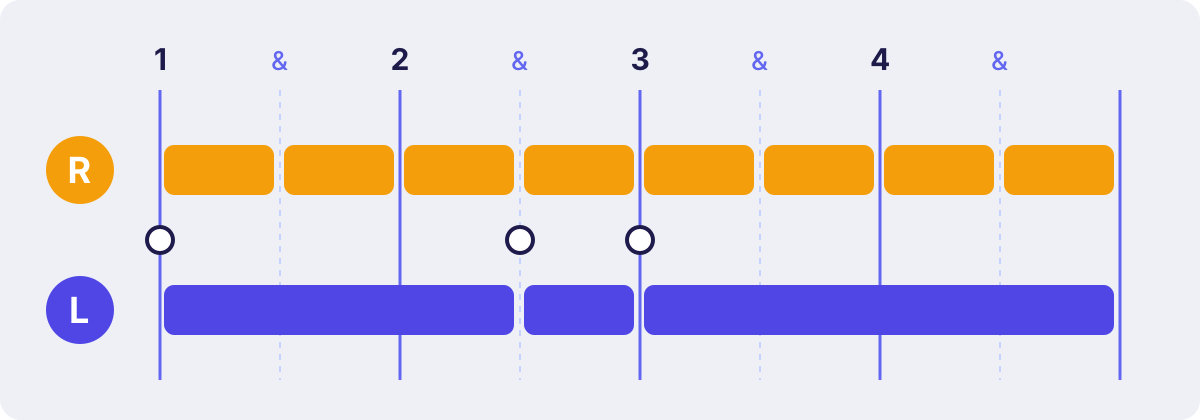
A step-by-step hands-separate to hands-together routine
Don't jam the hands together all at once. Build up through these stages, and move on only when you can play the current stage cleanly three times in a row with the metronome.
- Hands separately, counting out loud Play each hand alone at around ♩=60, saying "one-and-two-and" as you go. The goal is for each hand to own its rhythm.
- Tap it on your lap Away from the keys, tap the right-hand rhythm on your right thigh and the left-hand rhythm on your left thigh at the same time. With no notes to find, you can focus entirely on how the rhythms interlock.
- Play one hand, tap the other Play the right hand on the keys while the left taps your thigh, then switch. You're splitting the load: half notes, half rhythm.
- Mark the alignment points Draw a light vertical pencil line through every spot in the score where both hands play together. When you combine hands, lock in those points and the notes between them tend to fall into place.
- Combine at 50–60% of goal tempo If your target is ♩=100, put hands together at ♩=50–60, one bar at a time, then two. If it falls apart, slow down further. You don't need to go back to hands separately.
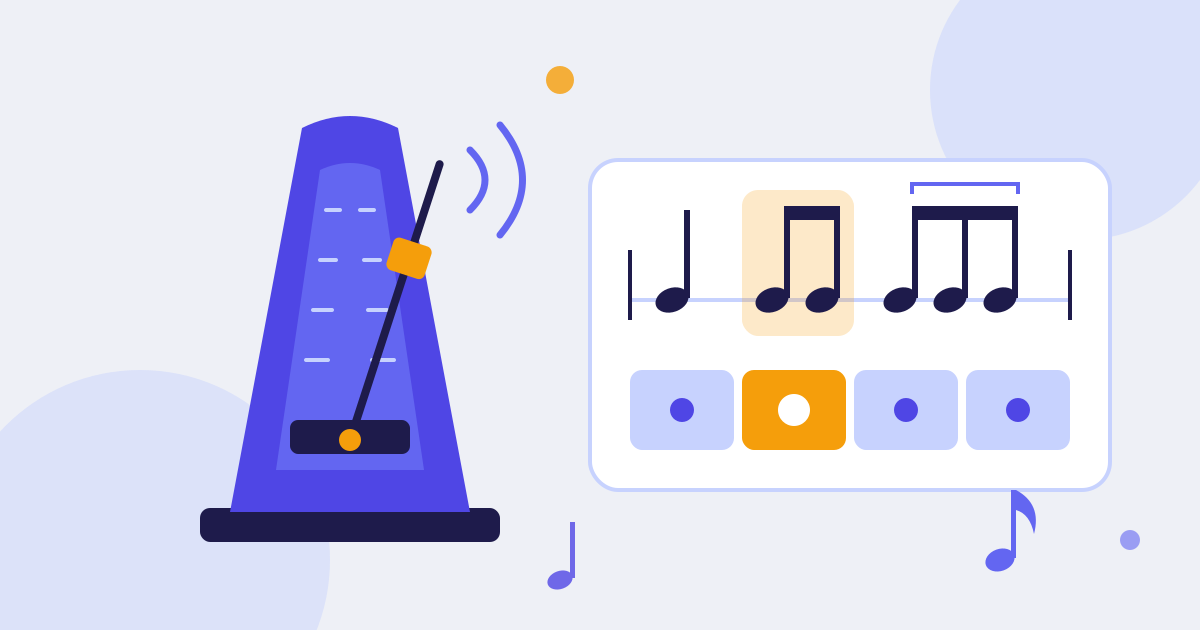
Sometimes it helps to hear how the two rhythms should fit before you try to play them. The Pro version of Rhythm Helper lets you enter separate left- and right-hand rhythms, shows both on one score, and plays them back with a different click sound for each hand while highlighting the note you should be on. It plays rhythm only, with no pitches, but hearing exactly how a tricky two-hand pattern lines up can make the first hands-together attempt much less confusing. The free version handles a single-hand rhythm up to two bars.
Piano Scales Practice: Order, Fingering Groups, and BPM Targets
Scales are boring, but most fast passages in intermediate piano pieces are fragments of scales and arpeggios. Ten minutes a day is plenty. What matters is having a clear order and measurable targets.
Learn the 12 major scales in this order
Instead of tackling scales at random, group them by fingering. Shared patterns stick much faster.
- C, G, D, A, and E major: the right hand uses 1-2-3-1-2-3-4-5 for all five, and the left hand uses 5-4-3-2-1-3-2-1. This is the ideal first group.
- B major and F major: one hand changes its pattern. In F major, the right hand's fourth finger takes the B♭.
- B♭, E♭, A♭, D♭, and G♭ (F♯) major: the black-key-heavy scales. Because your thumbs naturally land on white keys, many players find these more comfortable than C major once they try them.
This order mostly follows the circle of fifths, so you'll also absorb how key signatures add one sharp or flat at a time. Once the majors feel comfortable, add the relative minors in harmonic and melodic forms.
Metronome BPM ladder for scales
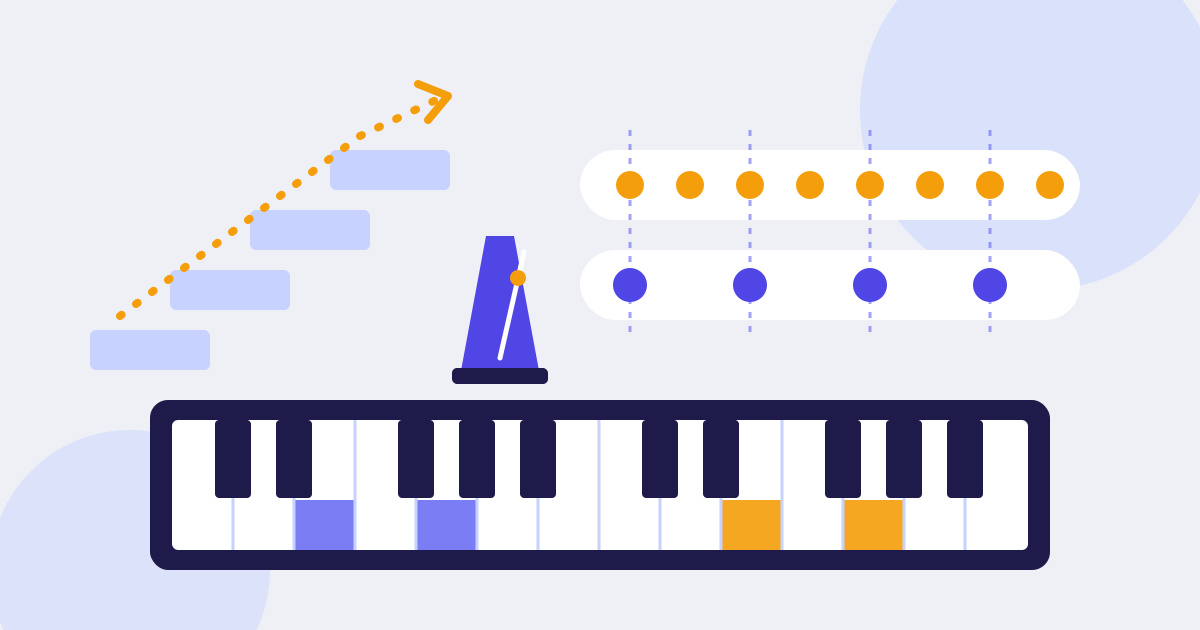
Scales only show progress when your targets are numbers. Here's a reasonable progression for a self-taught player. All tempos are quarter-note BPM, so adjust for your hand size and instrument.
| Stage | Range and hands | Note value | Metronome (♩) |
|---|---|---|---|
| 1 | 1 octave, hands separately | Quarters | 60 → 80 |
| 2 | 2 octaves, hands separately | Eighths | 60 → 88 |
| 3 | 2 octaves, hands together | Eighths | 60 → 100 |
| 4 | 2 octaves, hands together | Sixteenths | 50 → 72 |
| 5 (intermediate goal) | 4 octaves, hands together | Sixteenths | 72 → 96+ |
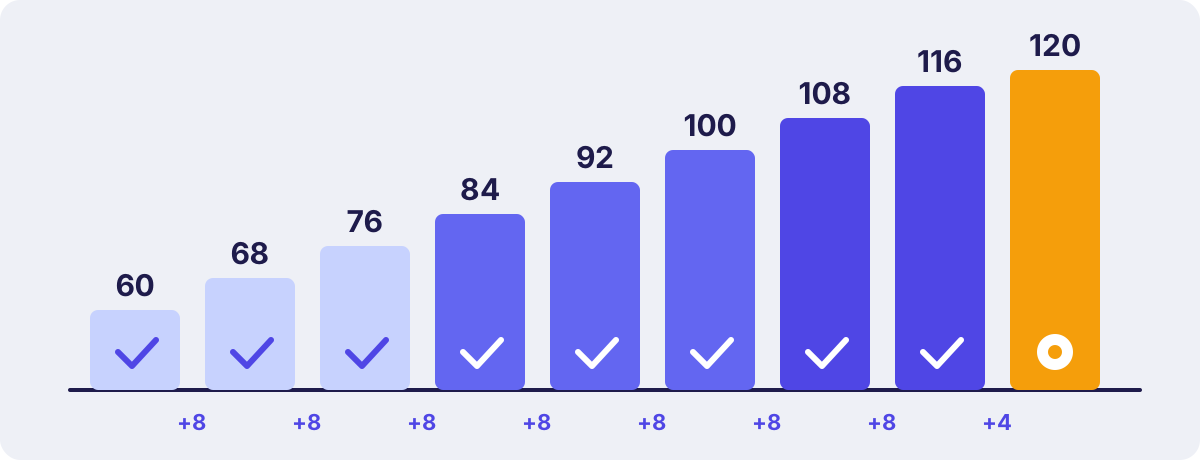
Start arpeggios once stage 2 of your scales feels solid. Begin with major triads (C-E-G) over two octaves, hands separately, in eighths at ♩=60. The most important thing to watch is the thumb crossing under: your wrist shouldn't jerk and the sound shouldn't break. Evenness comes before speed.
Chords and Accompaniment Patterns
Even if you only plan to play classical music, knowing your chords reveals how a piece is built and makes memorizing much easier. If you want to accompany pop songs or play from lead sheets, it's essential.
Progressions to know first
- I – IV – V – I (C–F–G–C in C major): the skeleton under a huge share of music. Aim to play it in all 12 keys.
- Inversions: playing C, F, and G in root position makes your hand jump around. Connecting them with the nearest notes, like C (root position) to F (second inversion) to G (first inversion), is called voice leading, and it makes everything sound smoother.
- I – vi – IV – V and ii – V – I: staples of pop and jazz. If jazz is calling you, our comparison of classical vs. jazz piano is a good next read.
Five left-hand accompaniment patterns
| Pattern | What the left hand plays (C chord) | Works well for |
|---|---|---|
| Block chords | C-E-G pressed together and held | Hymns, slow ballads |
| Broken chords | C-G-E-G or C-E-G-E in eighths | Gentle ballads, short pieces |
| Alberti bass | C-G-E-G (low-high-middle-high) | Classical-era sonatinas |
| Waltz bass | Bass C on beat 1, E-G chord on beats 2 and 3 ("oom-pah-pah") | Waltzes and minuets in 3/4 |
| Open arpeggio | C-G-C-E spread wide (1-5-8-10) | Pop ballads, film-score arrangements |
Pick one pattern and run it through I–IV–V–I in at least four keys. At first, let the right hand play just the top note of each chord in quarter notes, then add a simple melody once that feels easy. You'll notice this is hand independence practice in disguise.
Intermediate Piano Pieces: A Repertoire Path
Choosing pieces can make or break self-study. Pick something too hard and you'll spend months stuck on one piece while your motivation drains away. Stick to things that are too easy and you won't improve. A good rule of thumb: on a first look, a page should have only two or three bars that look genuinely hard. The path below reflects a common order. Difficulty varies by edition and by player.
| Stage | Example pieces and books | What you'll build |
|---|---|---|
| Late beginner → early intermediate | Burgmüller 25 Easy and Progressive Studies, Op. 100; early pieces from Schumann's Album for the Young, Op. 68 | Expression and articulation in short pieces |
| Early intermediate | Minuets from the Notebook for Anna Magdalena Bach; Clementi Sonatinas Op. 36, Nos. 1–3 | Two-voice texture, Alberti bass, Classical form |
| Intermediate | Kuhlau Sonatinas Op. 55; Satie's Gymnopédie No. 1; Bach Two-Part Inventions (Nos. 1, 4, and 8 are often suggested first) | Finger independence, counterpoint where both hands are equal partners |
| Upper intermediate | Chopin Preludes Op. 28 Nos. 4 and 7; Waltz in A minor (posthumous); selected Grieg Lyric Pieces | Pedaling, rubato, tone control |
The Bach Inventions are fantastic for hand independence, but because both hands carry melody, they often feel harder than they look at first. Chopin's easier pieces have few notes, yet the pedaling and balance are demanding, so it's worth spending real time on the earlier stages first. If you're still deciding on books, our guide to piano method books can help.
A balanced rotation is three pieces at once: a stretch piece slightly above your level, a comfort piece you can polish to performance standard, and one étude. If you only ever work on stretch pieces, you never get the satisfaction of finishing something, and burnout follows.
How to Get Better at Piano: Four Practice Tips That Actually Work
At the intermediate threshold, the difference between players who keep improving and players who stall is usually practice quality, not practice time. Playing the piece from top to bottom over and over mostly gives extra practice to the parts you already play well. Mix these four methods instead.
1. Slow practice
Play at 50–70% of your goal tempo with zero mistakes. It only works if you keep everything else exactly as it will be at full speed: the same fingering, dynamics, and articulation. If you can play it slowly but fall apart at tempo, you probably haven't skipped slow practice. You've likely skipped the in-between tempos.
2. Chunking (section loops)
Instead of the whole piece, isolate two to four bars around the trouble spot, including one bar before and one bar after. Stopping exactly at the mistake leaves the transitions into and out of it weak. When you can play a chunk cleanly five times in a row, move on, then stitch the chunks back together.
3. Rhythm variations
This is especially effective when a run of sixteenths sounds lumpy. Play the same notes in altered rhythms:
- Long-short (dotted eighth plus sixteenth), then short-long (sixteenth plus dotted eighth)
- Groups of four played fast, freezing on the first note of the next group
- Moving the accent to the first, second, then third note of each group
When you return to the original even rhythm, the unevenness between fingers is usually noticeably smaller.
4. Gradual metronome increases
Start at a tempo you can play cleanly. After three clean run-throughs, raise it 4–8 BPM. If you hit a wall, drop back two steps and climb again. Don't try to reach goal tempo in a single day. Starting the next session a little below yesterday's best is normal.
Sample 45–60 minute practice routine
- Scales and arpeggios: 10 minutes (following the BPM ladder)
- Étude: 10 minutes
- Stretch piece, section work: 20–25 minutes
- Sight-reading: 5 minutes (very easy music, played once without stopping; see how to read sheet music)
- Comfort piece run-through and recording: 5–10 minutes
Recording Yourself and Breaking Through Plateaus
Record once a week and listen back
While you're playing, your attention is on your hands, so it's hard to hear yourself objectively. Record audio or video on your phone, and if you can, wait a day before listening with the score in front of you. A short checklist turns a vague "that sounded bad" into specific tasks:
- Does the tempo rush in easy spots and drag in hard ones?
- Are the sixteenths even, or do certain fingers stick out?
- Does the melody sing above the accompaniment?
- Is the pedal blurring chords together?
Comparing today's recording with one from four weeks ago also reveals progress you can't feel day to day, which does wonders for motivation.
What to change when you hit a plateau
Feeling stuck for months around the intermediate threshold is extremely common. Changing how you practice usually helps more than adding hours.
- Drop the tempo hard. Check whether you're cementing mistakes by repeating at a speed you can't control yet.
- Play lots of easy music. Sight-reading two or three pieces a week from a level below raises your reading speed, which ends up speeding up your progress on harder pieces too.
- Switch styles. If you've only played classical, try playing a favorite song from chord symbols. If you've only played pop, try a short Bach piece.
- Schedule rest. A full day off each week often leaves your hands feeling lighter the next day.
When to Consider Lessons
You can absolutely reach intermediate on your own, but some problems are hard to spot without an outside ear. If any of these apply, lessons are worth considering:
- Recurring pain in your wrist, arm, or shoulder after practicing, a sign that posture or hand position needs checking
- No progress on the same issue (hands not lining up, an uneven passage) for three months or more
- You've reached things like pedaling, tone, and rubato, which really need someone to listen and correct
- You have a concrete goal, like an RCM or ABRSM exam or a recital
It doesn't have to be weekly lessons. Bringing a recording to a teacher once or twice a month for a check-up, or doing an online lesson focused on technique, fits well alongside self-study. Turn each lesson's feedback into your plan for the next month, and you'll get a lot out of every session.
The road to intermediate is longer than most people expect, but if you're heading in the right direction, you keep climbing. Ten minutes of scales a day, honest slow practice, and one recording a week will make a clear difference in six months. When a two-hand rhythm has you confused, entering it into Rhythm Helper and listening first is one more tool worth trying.
Frequently Asked Questions
How long does it take to reach intermediate piano when self-taught?
It varies a lot. Practice time, previous musical experience, and practice quality all matter, so there's no reliable fixed timeline. If you practice 30–60 minutes most days and focus on the weakest areas of the checklist above, progress becomes very noticeable. Measure yourself by how many checklist items you've covered rather than by the calendar.
How do I stop my left hand from copying my right hand's rhythm?
Most likely you combined hands before each rhythm was automatic. Tap the rhythms on your lap, mark the spots where both hands play together, and combine one bar at a time at 50–60% of goal tempo. Counting out loud with a metronome also helps keep one hand from being pulled along by the other.
How much time should I spend on piano scales practice each day?
Ten minutes is enough. Rotate through two or three keys per day and you'll cover all 12 majors in a week. Writing down your metronome tempos and raising them in small steps does more than adding extra minutes.
What are good intermediate piano pieces to start with?
Short, clearly structured pieces work best: Burgmüller's Op. 100 studies or Clementi's Sonatina Op. 36 No. 1. From there, many players move to Bach minuets and Two-Part Inventions for hand independence, then Romantic pieces like the easier Chopin Preludes for pedaling and expression.
Can I practice at an intermediate level on a digital piano?
Yes. Ideally choose one with 88 weighted, hammer-action keys and a proper sustain pedal. If the keys are too light, it's hard to develop dynamic control and finger strength. Our guide on how to choose a digital piano covers what to look for.