How to Play Triplets: Counting Eighth, Quarter-Note and Sixteenth Triplets
How to play and count triplets: eighth, quarter-note and sixteenth triplets, rests and ties, 2-against-3, duplets, quintuplets, sextuplets and a practice plan.
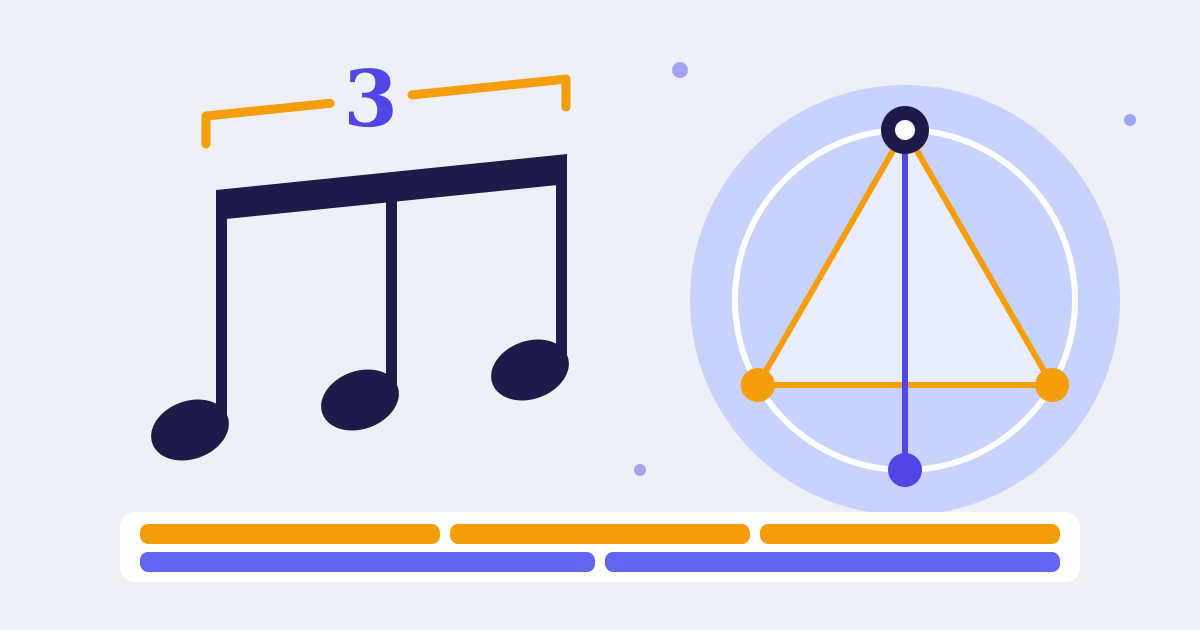
You are reading along fine, and then a little 3 with a bracket appears over a group of notes. Eighths and sixteenths feel manageable, but triplets come out lopsided: the first note is late, the last two get crammed together, and quarter-note triplets spread across two beats end up as a vague approximation. The reason triplets feel awkward is simple. Almost everything else we play divides the beat by two or four. Triplets use a grid of three that lines up with neither.
This guide covers how to play triplets and how to count triplets from the ground up: what a tuplet actually is, exactly where eighth, quarter and sixteenth triplets land, several counting systems, rests and ties inside a triplet (and why that is the secret behind swing), playing two against three, and how duplets, quintuplets, sextuplets and 6/8 time fit into the picture. It finishes with the most common mistakes and a step-by-step practice plan.
What is a tuplet? How triplets work
A tuplet is a group of notes that divides a span of time into a different number of equal parts than the time signature normally would. In 4/4, a beat (one quarter note) normally splits into two eighth notes or four sixteenths. If you want three equal notes in that beat, there is no standard note value that does it. So we write three eighth notes and put a 3 over them, meaning "fit these three into the time of two eighths." That is a triplet.
In other words, a triplet is three in the space of two. Some scores spell out the ratio as 3:2. Each note in the group lasts two-thirds of its written value, so an eighth-note triplet is a little shorter than a regular eighth and a little longer than a sixteenth.
How to spot triplets in sheet music
- The number 3 sits above (or below) the middle of the group, often in italics.
- A bracket shows where the group starts and ends. When the notes are already beamed together, the bracket is often left out and only the number remains. With unbeamed notes like quarters, or with rests in the group, the bracket is needed.
- Missing 3s: when triplets run through a whole passage, publishers often mark only the first few groups and then drop the numbers, sometimes writing simile. The rhythm has not changed just because the 3 disappeared.
The key idea is that a tuplet is defined by the time it fills, not the number of notes. A triplet group always lasts as long as two of the written note value. An eighth-note triplet group lasts one quarter note (one beat). A quarter-note triplet group lasts one half note (two beats). A sixteenth-note triplet group lasts one eighth note (half a beat). Once you know that, you can place any triplet you meet.
| Triplet type | Whole group equals | Time in 4/4 | Each note lasts |
|---|---|---|---|
| Half-note triplet | 1 whole note | 4 beats | 4/3 of a beat |
| Quarter-note triplet | 1 half note | 2 beats | 2/3 of a beat |
| Eighth-note triplet | 1 quarter note | 1 beat | 1/3 of a beat |
| Sixteenth-note triplet | 1 eighth note | half a beat | 1/6 of a beat |
Eighth-note triplets: three per beat, and how to count them
The triplet you will see most often is the eighth-note triplet. It splits one beat into exactly three, so the first note always falls on the beat, the three notes are evenly spaced, and the next group starts precisely on the next beat. The figure below lines up eighths, eighth-note triplets and sixteenths across two beats on the same time grid.
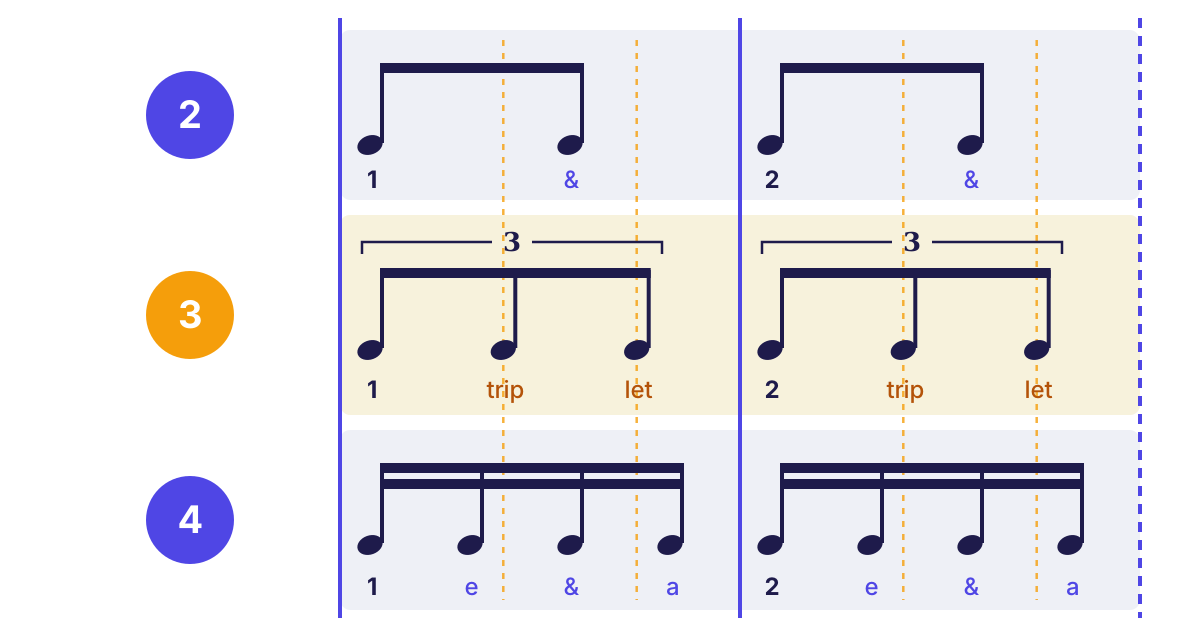
Notice that the second note of a triplet comes clearly before the "&", and the third note comes clearly after it. Hands trained on eighth notes tend to pull the middle note toward the "&", which turns an even triplet into a lumpy "da—da-da." Before anything else, get the sound of three equal notes with equal weight into your ear.
Ways to count triplets
There are several counting systems and any of them works. The one rule that matters: use the beat number only on the beat, and syllables for the other two notes. If you count "1 2 3 4 5 6," you lose track of where each beat starts and the whole bar drifts.
| System | One beat | Notes |
|---|---|---|
| Trip-let | 1-trip-let | The most common in English; the word itself reminds you it is a triplet |
| Eastman | 1-la-li | Widely used in US band and choir programs; light vowels that stay clear at fast tempos |
| Takadimi | ta-ki-da | Syllables mark position within the beat; every beat starts on "ta" |
| Three-syllable words | straw-ber-ry, cho-co-late | Repeat an evenly stressed word on each beat; the easiest way to feel the flow |
| Stretched numbers | one-ee-ee, two-oo-oo | Good at slow tempos for feeling the triplet without extra syllables |
Sixteenth-note triplets: three per half beat
Sixteenth-note triplets divide one eighth note (half a beat) into three, so two groups fill a beat and you get six notes per beat. Count them as "1-trip-let-&-trip-let" or "1-la-li-&-la-li," anchoring on the eighth-note "1" and "&" and filling the gaps with three. They show up in fast ornamental runs, drum fills and decorative classical passages. At most tempos counting every note is unrealistic; focus instead on whether each new group lands exactly on the "&" and the next beat.
Quarter-note triplets: three across two beats
Quarter-note triplets split a half note, two full beats, into three. They are the triplet players get wrong most often, because only the first note lands on a beat. The other two match no beat and no "&". If you tap your foot, the second note arrives just before beat 2 and the third arrives just after it.
The surest fix is to think of quarter-note triplets in terms of eighth-note triplets. One quarter-note triplet lasts exactly as long as two eighth-note triplets. So count six eighth-note triplets across two beats and play only on numbers 1, 3 and 5.
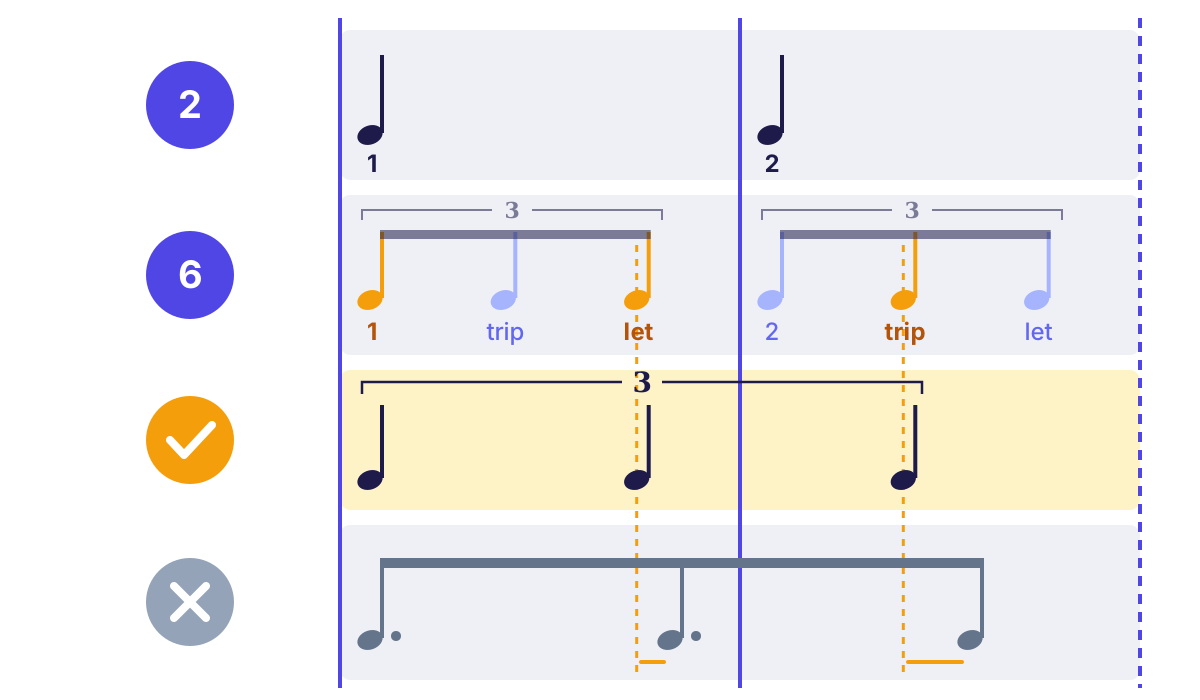
- Count eighth-note triplets for two beats Say "1-trip-let-2-trip-let" with a quarter-note metronome click. Around 60 BPM is plenty.
- Say syllables 1, 3 and 5 louder "1-trip-let-2-trip-let": speak the bold syllables out loud and whisper the rest. Those three bold syllables are your quarter-note triplet.
- Clap only on the loud syllables Keep counting all six, but clap three times. If the three claps sound evenly spaced, you have it.
- Remove the whispered syllables Gradually count the quiet syllables silently, then drop the numbers too, until what remains is the feeling of three claps evenly dividing two beats.
The same logic gives you half-note triplets (three across four beats): play notes 1, 3 and 5 of six quarter-note triplets, or simply divide a 4/4 bar into three equal parts. They appear occasionally in ballads and slow classical movements to stretch the phrase.
Rests and ties inside triplets, and where swing comes from
A triplet group does not have to contain three identical notes. Rests and longer notes inside the group create a whole family of rhythms on the same triplet grid. The positions never change, so read them by counting all three slots and playing only the ones that sound.
| Inside the group | Count (sounding slots in bold) | Feel |
|---|---|---|
| Eighth, eighth, eighth | 1-trip-let | The basic triplet, three even notes |
| Quarter + eighth (♩♪) | 1-(trip)-let | Long-short "doo-ba"; the building block of swing and shuffle |
| Eighth + quarter (♪♩) | 1-trip-(let) | Short-long, pushes forward |
| Eighth, eighth rest, eighth | 1-(trip)-let | Same positions as ♩♪ but the first note is clipped; very common in shuffles |
| Eighth rest, eighth, eighth | (1)-trip-let | Skips the downbeat, feels like a pickup |
The quarter-eighth triplet is the secret of swing
The second row, a quarter plus an eighth inside a triplet, is the shape everyone uses to explain swing. In swing jazz and blues, pairs of eighth notes are written evenly but played long-short, and that ratio is close to the 2:1 of a triplet. That is why many jazz charts begin with a swing marking showing two eighths equal to a triplet quarter-eighth. Real swing ratios change with tempo and from player to player, but when you are learning, starting from the triplet grid is the most accurate approach. For more on swing versus straight time, see classical vs jazz piano.
Triplets and ties
Ties often connect notes within a triplet, or connect the last note of a triplet to the next beat. A note that starts on the "let" and is tied over the following downbeat sounds like a syncopation that anticipates the beat. Read it like any other tie: play every note with the tie ignored first, then remove the sound of the tied-to note while still counting it. Just remember that ties inside the group follow the triplet grid, while a tie into the next beat lands back on the normal beat grid.
Two against three: playing triplets over a steady pulse
Playing an even triplet on your own is one thing. Playing it while something else keeps straight eighths is another. On piano, one hand in triplets and the other in eighths is the classic 2 against 3 (or 3 against 2) polyrhythm. In a band, a singer phrasing in triplets over a drummer's straight hi-hat creates the same tension.
Break it into a six-slot grid
The least common multiple of 2 and 3 is 6, so split each beat into six slots. Triplets fall on slots 1, 3 and 5; eighth notes fall on slots 1 and 4.
| Slot | 1 | 2 | 3 | 4 | 5 | 6 |
|---|---|---|---|---|---|---|
| Triplets (3) | ● | ● | ● | |||
| Eighths (2) | ● | ● | ||||
| Combined | both | 3 | 2 | 3 |
Combined, the hands make "together, triplet, eighth, triplet," a long-short-short-long pattern. The classic phrase is "nice cup of tea": both hands on "nice," the triplet hand on "cup," the eighth-note hand on "of," and the triplet hand again on "tea."
- Tap the combined rhythm with one hand Learn the composite "nice cup of tea" pattern alone first, until the long-short-short-long repeats evenly.
- Split it between two hands Right hand on slots 1, 3 and 5, left hand on 1 and 4. Slot 1 must land in both hands at exactly the same moment.
- Swap hands Put the triplets in the left hand and the eighths in the right. Pieces differ in which hand carries the triplets.
- Hear two independent lines Once it is comfortable, stop thinking about the composite and listen to each hand separately: an even three in one, an even two in the other. True 2-against-3 is two independent pulses.
On piano, Debussy's Arabesque No. 1 is often recommended as a 2-against-3 study, and the first movement of Beethoven's "Moonlight" Sonata layers a dotted-eighth-sixteenth melody over continuous eighth-note triplets. There, the sixteenth comes after the last triplet note, not with it. If hand independence itself is still the obstacle, start with the two-hand exercises in our intermediate piano self-study guide.
Duplets, quintuplets, sextuplets, and 6/8 time
Once triplets make sense, every other tuplet reads the same way. It is always a question of how many notes go into the space of how many.
| Tuplet | Ratio | Typical form | Where you see it |
|---|---|---|---|
| Duplet | 2 : 3 | Two eighths in one dotted-quarter beat of 6/8 | Compound meters such as 6/8, 9/8, 12/8 |
| Triplet | 3 : 2 | Three eighths in one quarter-note beat | Simple meters such as 2/4, 3/4, 4/4 |
| Quintuplet | 5 : 4 | Five sixteenths in one quarter-note beat | Classical runs, jazz solos, drum fills |
| Sextuplet | 6 : 4 | Six sixteenths in one quarter-note beat | Fast arpeggios and ornamental passages |
Duplets: two where there should be three
A duplet is the mirror image of a triplet. In compound meters like 6/8, where one beat (a dotted quarter) naturally divides into three eighths, a duplet splits that beat into two: two eighth notes marked with a 2. Each note lasts exactly half the dotted quarter, the same as a dotted eighth (some editions simply write two dotted eighths instead). You will rarely see duplets in 4/4; they belong to compound time.
Quintuplets: five in the space of four
A quintuplet usually puts five sixteenths where four would go, five notes per beat. It only shares the downbeat with the grids of 2 and 3, which makes it feel the most disorienting at first. Do not try to place each note against the beat. Instead, repeat five even syllables from beat to beat: "1-2-3-4-5" or a word like "hip-po-pot-a-mus," starting on the beat and finishing just before the next one. At fast tempos the realistic goal is to nail the first note and the next downbeat and let the middle flow evenly.
Sextuplets vs two triplets
A sextuplet puts six sixteenths where four would go, six per beat. In time, the notes land in exactly the same places as two groups of sixteenth-note triplets (3+3). The difference is grouping and accent.
- Two sixteenth-note triplets (3+3): written with two 3s, weight on notes 1 and 4. You hear three per half beat, "1-trip-let-&-trip-let."
- A true sextuplet (2+2+2): strictly, a sextuplet subdivides each note of an eighth-note triplet in two, so the weight falls on notes 1, 3 and 5. The larger pulse is three per beat.
In practice, many composers and publishers write a 6 even when the music clearly moves in 3+3. Rather than trusting the number alone, look at how the beams are broken and how the melody moves before deciding where the accents go.
How triplets relate to 6/8
Continuous eighth-note triplets in 2/4 at 60 BPM and continuous eighth notes in 6/8 with the dotted quarter at 60 sound identical. Both give you one big beat per second with three even notes inside. The difference is notation and context. When a simple-meter piece borrows a triplet feel for a moment, it is written with triplets. When the whole piece moves in threes, it is written in 6/8 or 12/8 from the start so you do not need a 3 over every beat. That is also why triplet-feel blues and ballads are often written in 12/8. For counting compound time, see how to count 6/8 time.
Where you will hear triplets: genres and pieces
Triplets are not just an exercise. They are everywhere in real music, and knowing the context tells you how a written triplet should feel.
- Swing jazz and shuffle blues: the quarter-eighth triplet from the previous section is the foundation of the groove. A shuffle is essentially the triplet with the middle note left out, "doo-ba doo-ba" without a break, and it drives a huge amount of blues and early rock and roll.
- Ballads: 1950s and 60s doo-wop and soul ballads are famous for piano chords repeated three times per beat. These are written either as triplets in 4/4 or directly in 12/8.
- Classical: the unbroken triplet accompaniment of the "Moonlight" Sonata's first movement, the breathless repeated-octave triplets in Schubert's Erlkönig, and the sixteenth-note triplets woven into the snare rhythm of Ravel's Boléro all use triplets to create mood and tension.
- Pop and hip-hop: in a song built on eighth notes, a quarter-note triplet creates a moment that seems to slow down and cut across the beat. Triplet drum fills and the rap "triplet flow" are other familiar examples.
Quarter-note triplets in particular love climaxes and bar endings, where they create the sense of stretching over the barline. Remember that the tempo does not change, only the subdivision does.
A step-by-step triplet practice plan and common mistakes
You can do all of the following with clapping or a single note on your instrument. Spend 10 to 15 minutes a day and move on once you get three clean passes in a row at around 60 BPM. For metronome strategy and when to raise the tempo, see metronome practice and tempo markings, and for rhythm work in general, how to practice rhythm.
- Secure the pulse Tap quarter notes with your foot and count "1 2 3 4" out loud. If the foot is unsteady, there is nothing for the triplets to sit on.
- Speak eighth-note triplets Keep the foot going and say "1-trip-let-2-trip-let." Check that each number lands exactly with the foot.
- Change gears: eighths, triplets, sixteenths Play one bar each of eighths ("1-&"), triplets ("1-trip-let"), sixteenths ("1-e-&-a"), triplets, eighths. The goal is that the beat does not move when the subdivision does. When it is easy, switch every two beats, then every beat.
- Take notes out of the triplet Keep counting triplets while playing "1-(trip)-let" (shuffle) and "(1)-trip-let" (rest on the beat). Count the empty slots all the way through instead of shortening them.
- Quarter-note triplets Count six eighth-note triplets across two beats and play only 1, 3 and 5. Then alternate a 4/4 bar of "two quarters + one quarter-note triplet" with bars of straight quarters.
- Two against three On a tabletop, learn the combined pattern first, then split it between the hands.
- Apply it to music and speed up Isolate the bars of a real piece that contain triplets, practice them slowly, and raise the tempo 5 to 10 percent after each success.
Common triplet mistakes
- A late first note and a crowded ending: bracing for the triplet makes the first note arrive late, so the last two get squeezed against the next beat. Think of dropping the first note onto the beat early rather than reaching for it.
- The middle note drifting toward "&": eighth-note habits turn the triplet into "da—da-da." Count with a three-syllable word and give all three notes equal weight.
- Quarter-note triplets played as dotted notes: the 3+3+2 error. The 1-3-5 exercise above fixes it.
- Rushing after the triplet: three notes per beat makes your hands feel busy, and that urgency spills into the next beat. Wait for the downbeat after a triplet rather than diving at it.
- Swinging after the triplet ends: the opposite problem, where the triplet feel lingers and the following straight eighths come out long-short. The gear-change exercise in step 3 cures this.
Hear the correct rhythm first with Rhythm Helper
Triplets, and quarter-note triplets and quintuplets in particular, are hard to imagine accurately, so it is easy to learn them wrong. That is where Rhythm Helper helps. Set the tempo and time signature, then enter the bar exactly as written: notes, rests, dotted notes and ties along with tuplets (2, 3, 5 and 6). The app draws it as notation with the brackets and beams grouped automatically, plays the rhythm back with a click on every note, and highlights the note you should be playing. You can enter triplets of any note value, such as quarter-note or sixteenth-note triplets, and duplets are available in compound meters like 6/8.
The free version runs in a web browser with no install and holds two bars, which is perfect for comparing "two quarters" with "a quarter-note triplet." Pro raises the limit to 32 bars and adds two-hand (left and right) rhythms, so you can enter triplets in one hand and eighths in the other, give each hand its own sound, and hear exactly how 2-against-3 interlocks. It does not record or grade your playing, so use a phone recording to check yourself. Listening to the correct rhythm in Rhythm Helper first and then teaching it to your hands is the fastest route.
Frequently asked questions
How many notes are in a triplet per beat?
Eighth-note triplets put three notes in one beat (one quarter note). Sixteenth-note triplets put three in half a beat, so six per beat. Quarter-note triplets put three across two beats, and half-note triplets put three across four beats. In every case, three notes fill the time normally taken by two of the written value.
What is the best way to count triplets?
The most widely used methods put the beat number on the downbeat and syllables on the other two notes, such as "1-trip-let" or "1-la-li." Beginners often find it easiest to start with an evenly stressed three-syllable word like "straw-ber-ry," then switch to a numbered system when playing real music so they never lose their place in the bar.
How do you play quarter-note triplets accurately?
Count six eighth-note triplets across two beats ("1-trip-let-2-trip-let") and play only on the 1st, 3rd and 5th: beat 1, the "let" of beat 1, and the "trip" of beat 2. The most common mistake is playing them as dotted eighth, dotted eighth, eighth (3+3+2), so listen carefully that all three notes are evenly spaced.
Is a sextuplet the same as two triplets?
The notes land at the same moments in time. The difference is grouping and accent: two sixteenth-note triplets (3+3) stress notes 1 and 4, while a strict sextuplet (2+2+2) stresses notes 1, 3 and 5. In real scores a 6 is often written for music that clearly moves in 3+3, so check the beaming and the melody before choosing accents.
What is the difference between triplets and 6/8 time?
At the same tempo, eighth-note triplets in 2/4 and eighth notes in 6/8 (counted in dotted-quarter beats) sound identical. Composers use triplets when a simple-meter piece divides the beat into three only occasionally, and 6/8 or 12/8 when the whole piece moves in threes. In 6/8, dividing a beat into two calls for a duplet.
How do I practice 2 against 3?
Split one beat into six slots: triplets fall on 1, 3 and 5, and eighth notes fall on 1 and 4. Learn the combined "together-3-2-3" pattern (the "nice cup of tea" rhythm) with one hand first, then divide it between two hands. The most important check is that both hands land together on slot 1.