How to Use a Metronome + Tempo Markings BPM Chart (Largo to Presto)
How to use a metronome and read tempo markings: what BPM means, accent and subdivision settings, a Largo-to-Presto BPM chart, and raising your practice tempo.
You open a new piece, see Andante or ♩ = 92 above the first bar, and wonder how fast that actually is. You switch on a metronome, set a number, and play along, but weeks later your timing doesn't feel any steadier. That's common: a metronome is only as useful as the way you set it up. This guide covers how to use a metronome properly and how to read tempo markings: what BPM means, how to set the meter, accent and subdivision clicks, a tempo markings BPM chart from Grave to Prestissimo, tempo change terms, dotted-quarter tempos in 6/8, and how to choose and raise a practice tempo.
We already cover the step-by-step metronome drills for building timing (clicks on 2 and 4, dropping the click out, and so on) in how to practice rhythm. This article focuses on the step before that: which tempo to practice at, and how to set the metronome up for it.
What is BPM? Tempo as a number
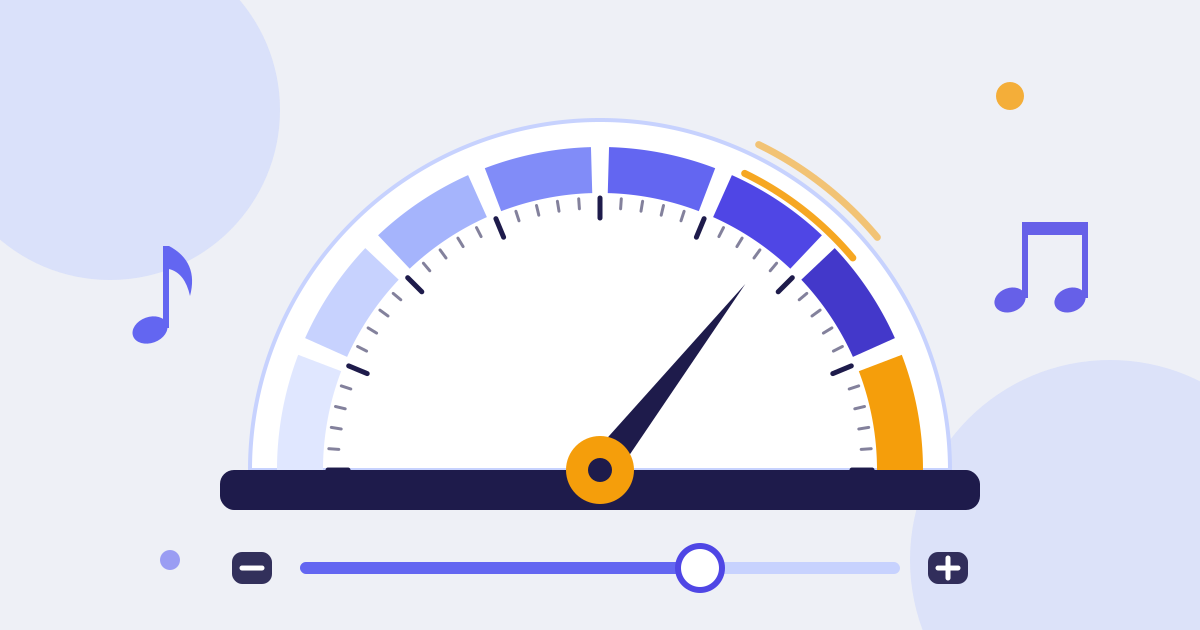
BPM stands for beats per minute: how many beats arrive in one minute. At 60 BPM you get one beat per second; at 120 BPM, one every half second. You can work out the length of a single beat as 60,000 ÷ BPM milliseconds, so 100 BPM is 600 ms per beat and 150 BPM is 400 ms. A higher number is faster, and doubling the number makes the same music exactly twice as fast.
♩ = 80 and "M.M." in sheet music
Scores write tempo as a reference note = a number. ♩ = 80 means "80 quarter notes per minute." Older editions often write M.M. ♩ = 80. The M.M. stands for Maelzel's Metronome, the mechanical metronome Johann Maelzel patented around 1815, which spread quickly through Europe. Beethoven was famously one of the first composers to add metronome numbers to his works, and the habit caught on. If you see ♩ = c. 100, the c. (circa) means "about": the composer is giving you some room.
The reference note matters as much as the number
Always check which note gets the beat before you look at the number. ♩ = 60 and ♪ = 60 share a number, but the second means one eighth note per second, which is ♩ = 30, half the speed. In the other direction, a half note = 60 in cut time (2/2) means one half note per second, the same speed as ♩ = 120. Dotted-quarter markings in compound meters get their own section below.
BPM isn't the whole story
Two pieces at 120 BPM can feel completely different if one is all quarter notes and the other is wall-to-wall sixteenths. BPM only tells you how far apart the beats are; how busy your hands are depends on how many notes fit inside each beat. So instead of thinking "120 is an easy tempo," judge a tempo by the shortest notes in the passage you're actually practicing.
How to use a metronome: meter, accent and subdivision
A metronome is more than a number. To do its job, it needs to match the meter of the piece and the goal of your practice. A classic mechanical metronome gives you a range of roughly 40–208 and a swinging arm, while most metronome apps let you choose the meter, accents and subdivisions as well. Set yours up in this order.
- Choose the BPM Find the tempo marking in the score, then start with a practice tempo below it. How far below is covered in choosing a practice tempo.
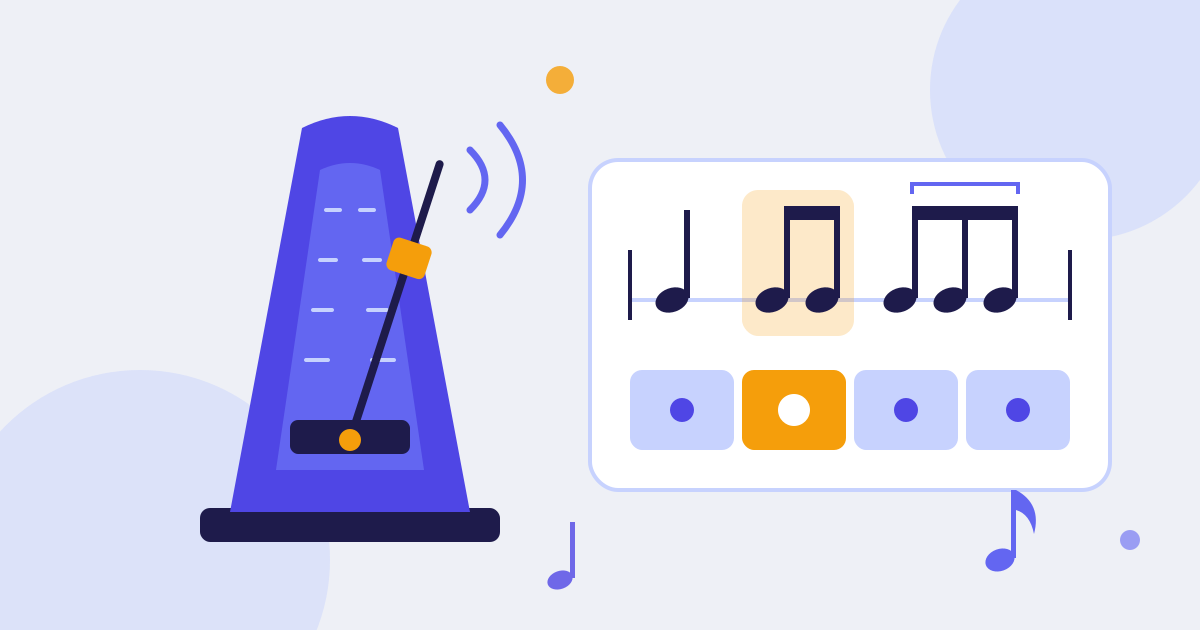
- Set the meter and accent Four beats per bar for 4/4, three for 3/4, with an accent (a different sound or a louder click) on beat one. The accent keeps you from losing your place in the bar, which helps a lot early on.
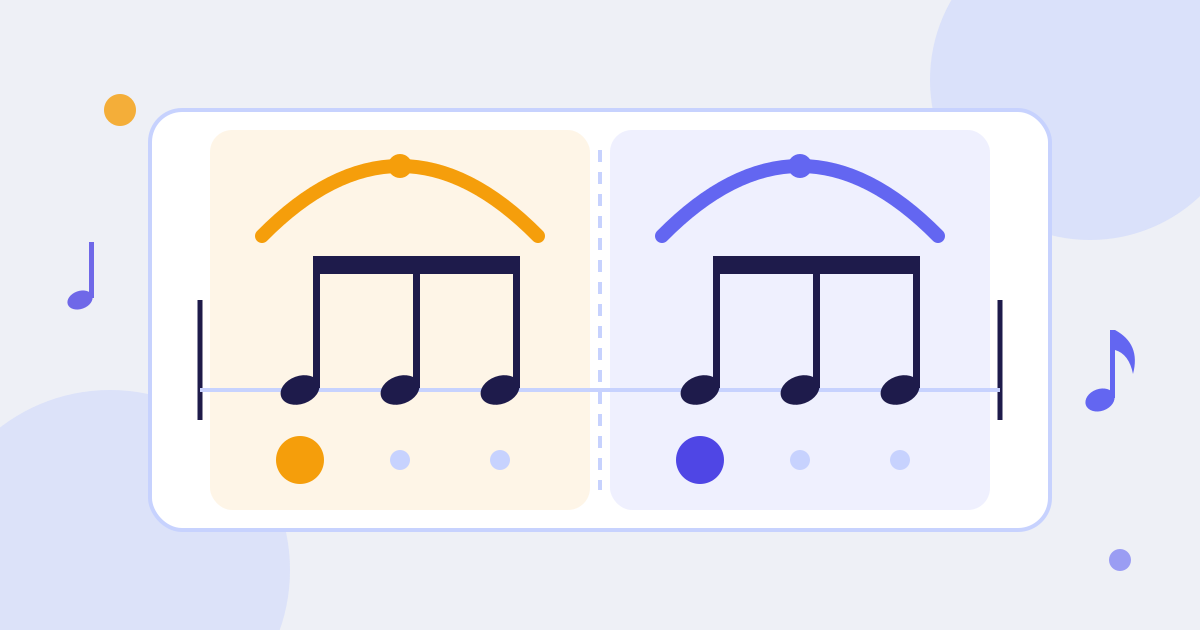
- Pick a subdivision Turn on eighth-note clicks for pieces full of eighths, triplet clicks when triplets appear, and sixteenths for sixteenth-note passages. Subdivision clicks fill in the space between beats and stop slow tempos from going slack.
- Set the sound and volume Pick a tone that cuts through your instrument without being grating. Short, dry woodblock or click sounds suit piano; brighter, sharper tones carry better over drums or an electric guitar.
- Count in for two bars Don't start playing on the first click. Count "1, 2, 3, 4" out loud with the metronome for about two bars, then come in. Starting with the tempo already in your body keeps the first bar steady.
Treat accents and subdivisions as training wheels
Accents and subdivision clicks are a big help while you're learning a passage, but if you leave them on forever, the metronome ends up counting for you. Once the passage is comfortable, switch off the subdivision first, then the accent, and check you can hold the tempo with a plain beat click. The next steps after that, such as clicking only on 2 and 4 or muting bars, are in the five-stage routine in how to practice rhythm.
Tempo markings BPM chart: Largo to Presto
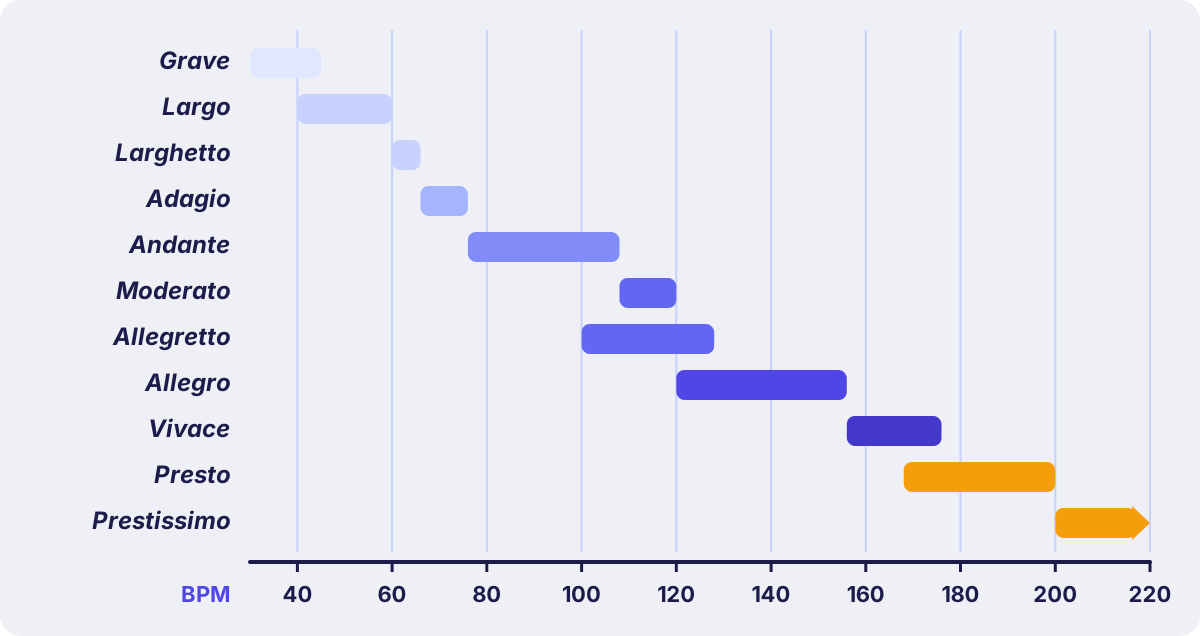
Tempo markings are Italian words that describe both the speed and the character of a piece. They were in use long before metronome numbers existed, so they were never meant as exact BPM values; they describe a mood and a kind of motion, like "at a walking pace" or "lively." That's why one composer's Allegro can be noticeably different from another's, and why textbooks and metronome makers print slightly different ranges. The chart below collects commonly quoted approximate ranges. Treat it as a starting point, not an official standard.
| Tempo marking | Meaning | Approximate BPM |
|---|---|---|
| Grave | Very slow and solemn, heavy | about 45 or below |
| Largo | Very slow and broad | 40–60 |
| Larghetto | Rather broad, a little less slow than Largo | 60–66 |
| Adagio | Slow, at ease | 66–76 |
| Andante | At a walking pace | 76–108 |
| Andantino | A little lighter than Andante (usually a little faster) | 80–108 |
| Moderato | At a moderate speed | 108–120 |
| Allegretto | Moderately fast, light | 100–128 |
| Allegro | Fast, bright and cheerful | 120–156 |
| Vivace | Lively and fast | 156–176 |
| Presto | Very fast | 168–200 |
| Prestissimo | As fast as possible | 200 and above |
The ones people look up most: Andante, Moderato, Allegro BPM
- Andante BPM: roughly 76–108. It literally means "walking," and it sits close to a relaxed walking step. The range is wide, so a calm Andante in the 80s and a lighter one near 100 can both sound right depending on the piece.
- Moderato BPM: roughly 108–120. Neither slow nor fast, and a favorite for études in beginner method books.
- Allegro BPM: roughly 120–156. It's usually translated as "fast," but the original meaning is closer to "cheerful" or "bright." Getting the number right is only half of it; an Allegro should also sound light and lively.
Modifiers you'll see next to tempo markings
Tempo words often come with qualifiers: molto (very), assai (very, quite), poco (a little), ma non troppo (but not too much), con moto (with motion) and sostenuto (sustained). Allegro ma non troppo means "fast, but not too fast," so aim for the lower end of the Allegro range; Allegro molto points to the upper end. The endings -etto and -ino soften the word: Larghetto is less slow than Largo, and Allegretto is less fast than Allegro. Andantino is the classic ambiguous case, but today it's usually played a little faster than Andante.
Tempo change terms: accel., rit., a tempo, rubato
Instructions that change the tempo mid-piece matter for metronome practice too, because the metronome won't follow you through them. Decide in advance where you'll turn it off and where it comes back on.
| Term (abbreviation) | Meaning | How to practice it |
|---|---|---|
| accelerando (accel.) | Gradually faster | Decide the start and end tempo, then practice the speed-up in two or three steps |
| stringendo (string.) | Pressing forward, faster | Like accel., but with building tension |
| ritardando (rit.) | Gradually slower | Stretch evenly to the last note instead of dropping off all at once |
| rallentando (rall.) | Gradually slower | Used almost interchangeably with rit. |
| ritenuto (riten.) | Held back, slower at once | Not gradual: the tempo drops immediately |
| a tempo | Back to the original tempo | Often follows a rit. Turn the metronome back on to check the tempo you return to |
| Tempo I (Tempo primo) | Back to the first tempo | Return to the tempo at the very start of the piece |
| meno mosso / più mosso | Less motion / more motion | Pick a tempo for the new section and learn it with the metronome |
| rubato | Freely stretching and pushing the tempo | Learn it in strict time first, then add the freedom on top |
Rubato in particular is often misread as "you don't have to keep time." Rubato is deliberate pushing and pulling against a steady beat; without that beat inside you, it just sounds unsteady. Even for very free-sounding pieces, learning them in strict time with a metronome first is the fastest way there.
How to find the tempo: the score, ♩. in compound meter, and recordings
1. Read the tempo in the score
Look above the first bar. If there's a number like ♩ = 112, put it straight into the metronome; if there's only a word, use the chart above to find a range. A new number or word later in the piece means the tempo changes from that point, so scan the whole score and mark those places before you start. Some pieces name a style instead, such as Tempo di Valse (waltz tempo) or Tempo di Marcia (march tempo). If the symbols themselves are still unfamiliar, start with our guide to reading sheet music.
2. 6/8 and other compound meters use ♩. =
In compound meters like 6/8, 9/8 and 12/8, eighth notes are grouped in threes and each dotted quarter is felt as one beat. So the tempo is usually written in dotted quarters, as in ♩. = 60. That means one dotted quarter per second, two big beats in a bar of 6/8, and eighth notes at ♪ = 180.
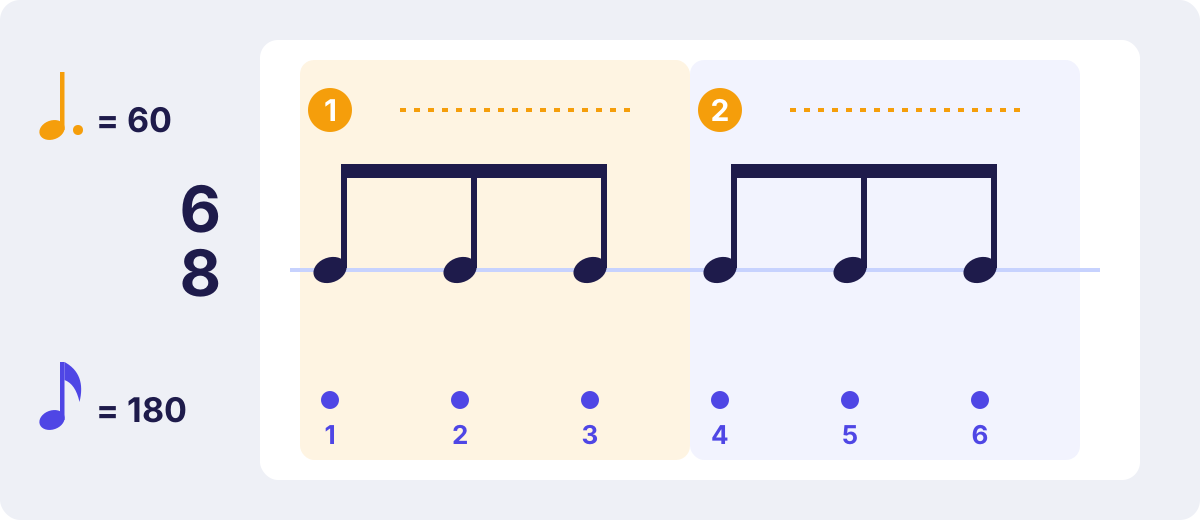
There are two ways to set the metronome: (1) set 60 BPM and feel each click as one dotted-quarter beat (if your app has a triplet subdivision, turn it on to hear the eighths), or (2) set 180 BPM and hear each click as an eighth note. Option 2 is easier for slow pieces and early practice; once the piece is under your fingers, moving to option 1 and feeling the two big beats sounds more musical. For counting 6/8 in detail, see how to count 6/8 time.
3. Find the BPM of a recording
When the score has no tempo, or you want to match a specific recording, you need to find the BPM by ear.
- Tap tempo: Many metronome apps let you tap a button along with the beat and calculate the BPM for you. The first few taps are always uneven, so tap steadily at least eight times before trusting the number.
- Count for 15 seconds: With no app, start a stopwatch, count beats for 15 seconds and multiply by 4. Thirty beats is about 120 BPM. It's rough, so set the metronome to that number and fine-tune it against the recording.
- Dial it in: Play the recording and nudge the metronome up or down until the click sits on the kick drum or bass for a long stretch. That number is the tempo.
The usual trap here is half time vs. double time. One person hears a ballad at 70, another at 140. Both are counting the same song in different units, so choose the one that matches the time signature and reference note in the score. For agreeing on a tempo and sharing a click track with a band, see how to run a productive band rehearsal.
Choosing a practice tempo and raising it with a metronome
If you practice at the target tempo from day one, you mostly rehearse your mistakes. If you only ever practice slowly, you never learn the motions a fast tempo needs, like relaxing and moving fingers in groups. Splitting the work into stages as a percentage of the target tempo keeps you in between.
| Stage | % of target | If target is ♩ = 120 | Goal of the stage |
|---|---|---|---|
| Reading and learning | 50–60% | 60–72 | Get through with the right notes, rhythm and fingering |
| Stabilizing | 70–80% | 84–96 | Repeat the same result while staying relaxed |
| Polishing | 85–95% | 102–114 | Add phrasing and dynamics |
| Target tempo | 100% | 120 | Play the whole piece through like a performance |
| Building headroom | 105–110% | 126–132 | Short bursts on hard spots, so the target tempo feels comfortable |
The basic rule for climbing between stages (three clean repetitions, then raise 5–10%; step back after a mistake) is covered in how to practice rhythm. For exercises like scales that are easy to track by number, the BPM ladder in our intermediate piano self-study guide is also useful. Below are a few techniques that complement that rule when you hit a plateau.
Two steps up, one step down
If you only ever go up, you eventually hit a wall where your hands tighten and the tempo won't budge. Mix in small retreats: up 8, down 4 (for example 80 → 88 → 84 → 92 → 88 → 96). Each step down gives you a moment of ease to check the motion is still correct, so things fall apart less often than with a straight climb.
Backward practice: build from the end
Practicing from the top every time leaves you with a polished opening and a shaky ending. Split the hard passage into bars and start with the last bar, then add one bar at a time in front of it (bar 4 → bars 3–4 → bars 2–4 → bars 1–4). You're always playing toward material you know well, so you reach the end far more securely at the same BPM.
Burst practice: short bursts at full speed
For fast passages that fall apart at the target tempo, play just a few notes at the target tempo and stop on the next beat. In a sixteenth-note run, that means "four notes, stop; next four notes, stop," then groups of eight and twelve as it settles. The pause lets you prepare the next hand shape, so you train the fast motion itself, which slow practice alone can't fully teach. Keep the metronome running: the key is landing each stop exactly on a beat.
Start each day a little lower
Starting at yesterday's best tempo with cold hands usually means starting with mistakes. Begin about 10% below yesterday's clean tempo and work back up within a few minutes. For repeated patterns like guitar strumming, guitar strumming rhythm practice walks through BPM stages pattern by pattern.
Hear the rhythm at the target tempo with Rhythm Helper
A metronome tells you exactly where the beat is, but not what the written rhythm should sound like on top of it. For bars full of dotted notes, ties and tuplets, try Rhythm Helper alongside your metronome. Enter notes, rests, dotted notes, tuplets and ties exactly as written, and it plays back that exact rhythm with a click on every note while highlighting the note to play. You can set the tempo with the −/+ buttons, by typing a number, with the slider, or by tapping a tempo marking. Its markings come with representative tempos (Grave 40, Largo 50, Adagio 70, Andante 92, Moderato 112, Allegro 138, Vivace 166, Presto 184), and in 6/8, 9/8 and 12/8 the tempo is shown as ♩. = N.
A good order is listen at the target tempo → drop to 50–60% and clap along with the highlight → practice on your instrument with the metronome. It's free in your web browser with no install for up to 2 bars, and Pro lets you enter up to 32 bars. Use a metronome for holding the beat and Rhythm Helper for checking the rhythm — the two work best together.
What to look for in a metronome app
There are countless metronome apps, but the things that matter for practice are much the same. Use these points, rather than any particular brand, to find one that suits your instrument and how you practice.
- Timing accuracy: The click should stay perfectly even over several minutes, with no wobble or drift. If you're unsure, run it alongside another metronome and listen for whether they stay together, or record it and check the spacing of the waveform.
- Sound and volume: Look for a tone that stays clear over your instrument, and enough volume to hear it.
- Meter and accent options: Can it do compound meters like 6/8 and odd meters like 5/4 as well as 2/4, 3/4 and 4/4? Can you move the accent?
- Subdivisions: Eighth, triplet and sixteenth subdivisions make slow practice much easier.
- Muted bars (gap click): A setting that plays a few bars and then goes silent for a few automates the "drop the click" exercise.
- Speed trainer: Automatically raising the BPM every few bars is handy for step practice. It goes up whether you nailed it or not, though, so keep the habit of stepping back yourself after a mistake.
- Tap tempo and visual cues: Tap tempo helps you find a recording's BPM; a screen flash or vibration helps when your instrument is loud.
Common metronome practice mistakes
- Starting at the target tempo — Repeating a wrong motion fast locks it in. Start at 50–60%.
- Ignoring the reference note — Reading ♩. = 60 as ♩ = 60, or a half note = 60 as ♩ = 60, changes the tempo dramatically.
- Treating tempo markings as numbers only — Allegro is "fast" but also "bright"; Grave is "slow" but also "heavy." Once the BPM is right, listen for whether the character is there too.
- Reacting to the click — If you wait to hear the click and then play, you'll always be slightly late. Anticipate the next click and arrive with it.
- Leaving subdivisions and accents on forever — Lean on extra clicks and your time collapses the moment they're gone. Switch them off one at a time.
- Camping at one tempo — Practicing only one BPM means you can only play at that BPM. Move up and down so you experience a range of tempos.
Frequently asked questions
What does BPM mean, and how fast is 60 BPM?
BPM means beats per minute. 60 BPM is one beat per second, the same as a clock's second hand, and 120 BPM is twice that, one beat every half second. Always check which note counts as the beat too, as in ♩ = 60.
What BPM is Andante?
Andante is commonly given as about 76–108 BPM. It means "at a walking pace," so the range is wide and the exact boundaries vary between sources. If the score gives a ♩ = number, follow it; if not, choose a tempo in that range that suits the mood and lets the fastest notes sound natural.
What BPM are Allegro and Moderato?
Moderato is usually listed at around 108–120 BPM and Allegro at around 120–156 BPM. There's no single official standard, though, and real performance tempos vary a lot by era and composer. With Allegro, capturing its bright, cheerful character matters as much as the number.
How do I set a metronome for 6/8 time?
If the score says ♩. = 60, either set 60 BPM and feel each click as one dotted-quarter beat (three eighth notes), or set 180 BPM and hear each click as an eighth note. Eighth-note clicks are easier at first; once the piece is comfortable, feeling the two big beats is more natural.
The score only has an Italian tempo word, no number. What tempo should I use?
Use a tempo markings BPM chart to find a rough range, then choose a tempo within it where the shortest notes in the piece still sound clean. Listening to a few recordings and checking their BPM with tap tempo or a 15-second count helps narrow it down.
Should I keep the metronome on the whole time I practice?
No. It's useful while you're learning a new passage and raising the tempo, but once it's comfortable, turn off the subdivision and accent clicks, work through muted-bar practice, and aim to hold the tempo without any metronome. Make sure you also spend time with it switched off, focusing on expression.